Thursday, September 2, 2010

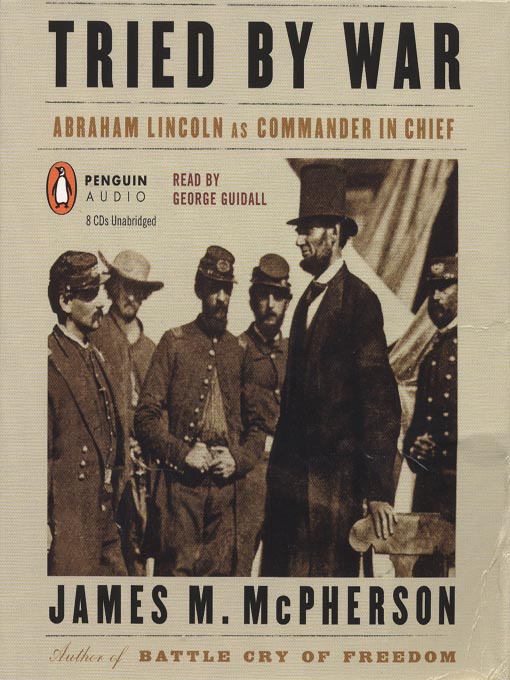
Tried by War by James McPherson

[Listened to this as an audiobook, if that matters to anyone.]

It's been awhile since I've had the pleasure of sitting down with a Civil War book. They tend to be a bit on the long side, and I've not had a lot of time to myself for pleasure reading. I decided to take advantage of my new, longer commute to pick up this study in command by James McPherson.

McPherson is a well-regarded historian who, I am somewhat embarrassed to admit, I've never read. There's a lot of Civil War books out there, and by the time I got to McPherson, I was already reading more specialized works on the war.

This book, however, intrigued me because of the subject matter. We all talk about Lincoln as being a great president, but the details as to why don't often get looked at very closely.

In this case, going from Lincoln's pre-inauguration days to the tragedy of his death, McPherson shows the progression of a man who knew about as much on the practice of war as I do on trigonometry when he first took office. By reading books, listening to a wide variety of opinions, reacting to practice, and dealing with the realities of war. In addition, Lincoln had to also juggle political actors, public opinion, and his own personal demons.

Any one of those things would be enough to break a lesser man, but Lincoln, in this rather glowing portrayal by McPherson, rises to the occasion. Honest Abe, despite his doubts, seems to be one step ahead of almost everyone around him, from the crafty cabinet members like Chase and Seward to military minds as diverse as Scott and McClellan.

In McPherson's account here, Lincoln had the right idea all along--he just didn't have the generals to implement the plans, until Grant, Sherman, Sherridan, and Thomas (an odd inclusion) came along. Once that quartet is in place, it's only a matter of time.

Similarly, Lincoln walks the tightrope of slavery here in a way that makes it seem as though the 16th president quickly transitioned from fighting for union to fighting for freedom, despite the displeasure of many around him. Father Abraham is nearly worshiped by freed slaves, and in the process, the struggles black soldiers faced to just get on the field (and be used in a meaningful way) is hidden into the background, with Grant's blatant racism completely overlooked.

True, McPherson does highlight Lincoln's failure with political generals and a few other mistakes, but they are waived away as being beyond Lincoln's control. The problem is that in the process, it looks like McPherson wants us to have it both ways--Lincoln is praised for his virtues, but not shown as being responsible for for his faults. It's a throwback to an earlier type of history book, where heroes are made to look as good as possible. I'm just not comfortable with the level of hero-worship on display here.

I also disliked the way that McPherson ignores the factors on the other side of the field that may have led to some of Lincoln's (and Grant's) successes. Jefferson Davis, despite being a former Secretary of War, was an idiot as a commander in chief. I also think even someone as cautious as McClellan could have won on the field by 1864, when the south's resources just dried up. Yes, the Union had a lot of bad generals, but the Confederacy had a lot of good ones, too. In the name of making Lincoln look better than his generals, I don't think McPherson properly takes circumstances into consideration.

There's also the tricky issue of Lincoln's shaky stance on the Constitution. Lincoln did a lot of things to create the Imperial Presidency, a style of managing that's great when it works, but lousy when the President's plans are less than stellar. McPherson says "other did worse" as the answer to this challenge to Lincoln's legacy, but overlooks that they all did it because *Lincoln did it first.*

Overall, Tried by War was a fun read, because it highlighted just how much Lincoln was involved in the war effort. As President, he acted in ways no one else has before or since, and his keen intellect often had the right idea. Focusing on Lincoln's army stovepipe hat is a worthy endeavor, and those looking to learn more about Lincoln's role in the war could do worse than to start here. I just wish McPherson had been willing to be more critical, or at least acknowledge there was more at play than just the Union side. When you finish Tried by War, I think you'll agree.

Wednesday, August 11, 2010

American Creation by Joseph Ellis

The founding of America was a rather amazing time, even if you don't feel that the leaders at the time were perfect men who were getting their inspiration from a higher power.

Writer Joseph Ellis has made quite a reputation writing modern biographies and period studies of the men who lived the first twenty-five years of America. I'd read Founding Brothers by him some time ago, and was quite pleased with the book, feeling as though he'd spent just about the right amount of time on each subject.

I do not like history books that are either trying too hard to capture the casual audience of the History Channel or dig so far into the minutia that I want to throw the book but at 800 some pages, it's too heavy for me to pick up. Ellis's writing style tries hard to balance the two, which is just what I want out of a modern text.

In American Creation, another book dealing with concepts rather than a single subject, Ellis once again gives a good accounting of the history but does not lay it on so thick that the reader becomes bored. By the end of each chapter, I found myself wanting to read just a bit more about each incident described, which I think should be the goal of any author not trying to write the definitive biography of a person or event.

Take his discussion of Washington's dealings with the Native Americas, for instance. I had no idea that, relatively speaking, the old general was a progressive when it came to the rights of the American Indians. In Ellis's hands, Washington is a man trying to do the right thing, within the needs of his new country, but the racial and commercial desires of the majority of the country are too much for his aura of respect and deference to overcome. It's a fascinating story of which I was previously unaware, and I definitely would like to know more.

As an aside, I wonder if maybe the problems with carving out territory for Native Americans didn't contribute to keeping the slavery problem on the back burner for so long. If Washington couldn't get any traction on this issue, how could he on slavery, even if he wanted to (which I don't know if he did)?

The section of "The Treaty" was by far the most interesting for me, but every point that Ellis tackles is a good touchstone. 1776 (with a bit of 1775 thrown in) is called "The Year", and focuses on what happens when you try to start a revolution. Valley Forge is given a new perspective as a time when the soldiers who would later be statesmen (and Federalists, for the most part) determine a national government is needed to sustain the revolution. Formation of political parties is given a big role, despite America's distaste for them. Rounding things out, Jefferson's hypocritical use of power to double the size of the United States is the springboard that moves American onto the international scene, just by its very scope.

These are all good points of discussion, and Ellis gives them a pretty good airing. My problem is that Ellis has an agenda of his own, and it seems into his writings here. I don't know if it comes from his feelings or the desire to tap into the patriotic feelings after the events of 9-11, but the idea that America was (and is) better than everyone else and even in getting things wrong, we got things right, is troubling to me.

Ellis has a tendency to make the founders seem like they had created a perfect system, and that America's path is the only way that will work, and all others are swept aside to history's dustbin. Try telling China that, given they own a good chuck of this perfect government's debt. It blinds him at times and makes it seem like there weren't other paths to take that might have worked just as well. We cannot know for certain, and Ellis leans heavily on the hindsight of a historian to declare that the choices made were the correct ones.

A typical example are his thoughts on the slow path to leaving the British Empire. He claims that historians on the left see this as a moral failure, but doesn't back that comment up. Instead, he goes on to state,

"In my judgment the calculated decision to make the American Revolution happen in slow motion was a creative act of statesmanship that allows the United States to avoid the bloody and chaotic fate of subsequent revolutionary movements in France, Russia, and China."

The fact of the matter is, it wasn't a decision made to avoid a bloody fate, it was because there were quite a few people in America (I've read that it may have even been a majority!) who didn't want to leave the Empire at all. There was no way to do this quickly, because trying would have led to conflict within the colonies themselves.

I completely disagree with Ellis here, as well as anywhere else that he posits that the folks making the decisions at the time knew exactly what they were trying to accomplish--the creation of the "best" government. That's an argument made by people who feel that America is perfect and those who criticize it are wrong. We have it better here than in a lot of other places, true, but that's not because John Adams was worried about how things were going to play out in the centuries to come--he was just worried about staying alive to make it 1777.

Time and time again, the decisions made by the Founding Fathers were on a practical level, not on one designed to make a country last for hundreds of years. They took the time to make sure that any decision put off hard choices, and only came together when things were so bad as to be untenable, such as the failure of the Articles of Confederation. It's a pattern we see over and over again in this nation's politics, and we suffer for it every time.

Practicality may have made America more stable than in other places, but it also sowed the seeds for later problems. To argue that America's history is not bloody is to ignore the Civil War, the Civil Rights Movement, and other times during which people died to fix the flaws of the people that started this whole country. I realize that Ellis specializes in early American History, but to ignore the deaths that happened later in the struggles for this nation over the past 200 years and to say that the only alternative to America's system is Islamic fundamentalism is a terrible oversight for a historian who should know better. Even a casual knowledge of history after the early 1800s and world history in general should result in blanket statements that are not so obvious in their mistakes.

It is not within the scope of this review to argue each of Ellis's points, and I only bring the above up to show what a person who reads a lot of historical non-fiction needs to be prepared for if they opt to pick up this book. There are plenty of other points I could discuss--Ellis calling political parties necessary to harnessing the energy of democracy, completing ignoring the party machines used over the years is another sticking point for me--but I think the example I used is enough to show that if you view all history with a critical eye and an open mind to what could have been, you are going to have some issues with Ellis's take on the forming of America.

Despite my problems with Ellis' editorializing, I did enjoy this book. He's obviously done his research and is just as passionate about his time period as Bruce Catton was with the Civil War. I want that in a writer, as that passion shows and makes for compelling reading. It also, unfortunately, creates blind spots that I feel any reader should be aware of and ready for. Who knows, you may even agree with them and feel my view is flawed. I worry more for those who are reading this without any background knowledge or the time/desire to read more on the subject. For them, this may be the only take on the material and time, which I think would be a shame.

Overall, American Creation is just as human as those Ellis writes about. It's a great starting point for those looking for new areas to explore during America's early years. Just don't take it as gospel and you should be fine.

Tuesday, August 3, 2010

Blockade Billy by Stephen King

Sometimes I feel a little strange when I'm writing up my first review for a book by a major author, because while I may have been reading them for years, this could be their first appearance on the blog.

Thus, if I'm not happy with the book I read, it can feel like I don't like the author, which is often not true. Such is the case with Blockade Billy, a book that feels like it could have been a lot more had King taken the time to write it well instead of tossing it out there in time for baseball season.

Blockade Billy is the story of a baseball player no one's heard of, because he's been erased from the record books. Only a few old timers know him, and one is willing to tell all to King himself, as it beats the boredom of sitting in a nursing home.

Soon we learn about Billy, an amazingly talented ballplayer that clearly has something to hide. As we move deeper into his magical season, you know something has to give, and it does--with a bang that's about as obvious as when a player is out at home by 30 feet.

Written in the narrative style with multiple references to the old ballplayer talking to King, it's formatted much like Deloris Claiborne, another King work I wasn't fond of, for much the same reason. Both tales never offer much on what the promise and in the end, I was disappointed. The twists just don't materialize, and I expect better from King as a writer.

In the case of this book, part of the problem is length. This book is barely 50 pages long, and I was able to read it in only a little over a half hour. As a magazine story, which was much of King's early career, it might have worked. As a novella, with the King name attached, I figured on a lot more writing. Its brevity is not refreshing for the wordy King. Instead, it constricts him, and leaves time only for a quick summary of the details as to why Billy's tale must come to the end it does.

From what I understand, King wrote this in about two weeks, and it shows. There's little plot, the character of Billy is a cipher, and if you don't know much about baseball, I'm not sure this book will mean anything to you. The trouble is, if you *do* know a lot about baseball, King's puzzling decision to make his team major-league level just creates all sorts of logistical headaches for no good reason. (Perhaps the biggest of which is the way in which Billy gets on the team in the first place. No big league club, even in this 1950s setting, would have done what this fake team from Jersey does.)

Billy could easily have played for a minor league team, and still do all that he does. In fact, the drama of having him come so close to being in the bigs before the crucial moment would have added so much. That's a lost layer of drama here.

Unfortunately, that's what happens when you rush things. Details that might be otherwise thought out get missed, and it mars the overall quality. Blockade Billy's logical leaps, obvious conclusion, and wandering text all make me nostalgic for the days when books were given stricter editing.

It doesn't help that the ending, while predictable in terms of general concept, throws more things at you as a reader than a five-tool pitcher. So many gaps in the story are covered in the last ten pages, you'd think it was a set of working notes rather than finished product. I appreciate the closure, but if your story is that complex, then take the time to flesh it out. There's no harm in more pages, especially when you're Stephen King.

I also found the setting to be weak, despite efforts to ground the text in the past. It's obvious King knows and loves his baseball history, but the references to vintage players don't fall into place very well. It's name dropping for name dropping sake. The idea of a simpler time when the game was played hard is probably what's supposed to come across, but I just didn't get anything other than a feeling of grumpiness. It didn't make me pine for the old days--except maybe Stephen King's old days.

The narrative style of the book is vintage King, and you either like it or hate it by now, after he's had such a long career. This narrator talks like so many others in King's books, and I like it, except when they're narrative first person, as this one is. The natural tone of King's best characters just feels forced to me when I have to read it like this. Let the point of view stand on its own, and don't get in the way with comments about needing water, especially if you've already done that before in your career.

Stephen King may love baseball, but his two attempts at it in fiction, Blockade Billy and Girl Who Loved Tom Gordon, just don't serve his beloved sport well. He's an all-star writer that in this case, managed to strike out. For the price of this book and the size of its text, Blockade Billy just isn't recommendable. I'd turn elsewhere for my baseball or King fixes. Maybe next time the two meet, the results will be better. For now though, let this one ride the pine.

Monday, July 26, 2010

Year's Best SF 15 edited by David G. Hartwell and Kathryn Kramer

I've picked up a few of these collections by Hartwell over the years, but as with a lot of books I own, I hadn't really sat down to read them. They went in the mental "someday" list and kinda got forgotten.

If the prior 14 volumes are as good as this one, I'm going to have to move them up the to-read list pretty quickly.

Year's Best SF had everything I'd want from a collection in this genre--a few alternative histories, a few space stories, a few tales that might happen someday soon, a few literary pieces, and a few that blend between sci fi and other genres. More often than not, these stories featured a combination of those elements, which was even better.

The fact that I liked almost all 24 stories spread across nearly 500 pages is no small feat. I'm usually happy when an anthology gives me about a 2:1 ratio of like to dislike, so this was a pleasant surprise. There were really only a few tales that just didn't do anything for me, mostly the hard SF material that gets so bogged down in showing off the author's technical knowledge that they forget to hook me on the characters.

Hartwell and Kramer give a short introduction to each author, which is quite helpful to see what they've done before and what they're working on. They also talk about why they selected a particular story, allowing the reader to either agree or disagree after finishing the tale. I liked this feature, as it gave me some insight into the editor's minds, even if I didn't always agree.

My disagreements were few and far between, however. The editors felt that Charles Oberndorf's "Another Life" might have been the best SF story of the year, and it's hard to argue with them.

A man who lives in a world where bodies can be changed as they age (for the right price, of course) talks about his past selves to a woman who's opted out of the world of changing people. It's his confession to a person who loves him but never got to know him, and all the pain of telling the most intimate details of your life--and waiting too long to do so--come through in every page. If that's not enough, the body switching also means gender-swapping as well, adding a layer of complications that soon become clear as the story goes on. "Another Life" shows that you can include sexual themes in your fiction without them feeling forced or used to get a reader's attention.

The pain and unintended consequences of the future technology shine here, as Oberndorf quietly lays out the problems inherent in losing yourself over and over again. The ending is as perfect as it is heartbreaking. To me, this is the perfect science fiction story, because there is no way this could be told using the reality of today, and yet it also features the same emotions and complications that can happen in our world.

It's a shame this didn't get a Hugo Nomination, but I am really glad to have had a chance to read it. Sadly, Oberndorf does not write very often anymore, which is a shame because I'd love to have more of this to read.

From a comics geek perspective, it was nice to see Paul Cornell make it in for his story that did get nominated for the Hugo, "One of Our Bastards is Missing," a tale of intrigue in a world where the royalty of Europe still rules the day and an independent-minded royal princess is the subject of a plot to redraw the political map. His main character is your typical hardened black ops person, able to deal with any situation, even one in a world where guns can be hidden in "pockets" of the world. The concepts are not all that new, but the ways in which Cornell uses them made this another of my favorites.

I'm afraid the other Hugo-nominated story in this collection, "The Island" by Peter Watts, just didn't do anything for me. It was just too focused on the situation and not enough on characters that I wanted to read more about, and that's my main hook for any story. Those who prefer more technical stories than I do will probably have reverse feelings about these two tales.

Other former Hugo winners are in this collection, such as Nancy Kress, who pens a story that's a bit overly clever about how objects aren't the only thing that can have different interpretations over time. I found the idea to be cute, but I'm not sure I'd think of it as something to label the best for a given year.

Robert Charles Wilson, who did not impress me when I read Spin a few years ago, is also a Hugo veteran for that same book. I liked him a lot better here in the short story, "This Peaceable Land; or The Unbearable Vision of Harriott Beecher Stowe." An alternative history where the Civil War never happens and slavery is fazed out in a way that leads to a horrible, racial purity solution, Wilson makes sure that the reader is uncomfortable with this peace that came at a similar price to the Civil War, albeit in a different way. When the two main characters are forced to think about the cost of peace, the words unsaid are larger than those that are. It's a great use of historical what-if to address a philosophical question. If this is more typical of Wilson's prose, I'll have to give him another chance.

"Edison's Frankenstein" is another alternative history that references the Civil War, though in a far more casual way. Chris Roberson pens a world in which a technology from the sea powers the world, instead of electricity. Tesla is a famous sci fi novelist (great touch) and Edison is trying to find a way to keep his life going. What lengths has he gone to prove his point? It's a bit of a gotcha story, but the clues are there when you stop to think about them. I don't think the author quite hit this one as strongly as he might have in a longer form, but it was entertaining.

A Frankenstein of a different kind figures prominently in "The Consciousness Problem," where Mary Robinette Kowal provides an ethical dilemma in cloning I'd never considered. Her solution may not be one you agree with, but it's definitely food for thought. Ethics also frame Marissa K. Lingen's "The Calculus Plague," where a scientist tries to infect people with smarts and sees it all go wrong.

Science fiction often allows a writer to explore themes in a way we can't in non-fiction, and I could probably add "The Fixation" and "Erosion" to the list of stories in this collection that ask us to look at what we're wishing for. The former is science without considering the consequences and the latter reminds us that asking to live on beyond our time may not be the best plan, even as we try ever-harder to live longer and in places we were not meant to go. All of these stories remind us that in our rush to do things not even imagined 100 years ago that sometimes we may need to take a few minutes to think, "should we do this?", a lesson the nuclear bomb should have taught us but we never stopped to pay attention to.

Not every story is so serious, however. "The Highway Code" by Brian Stableford reminded me of a children's story, and not in a bad way. A self-aware engine breaks the rules, at great cost. Is he a hero or a villain? There are a few underlying concepts if you look hard enough, but it's also fine as just a fun surface read. Its placement at roughly the halfway point makes for a nice breather. I have a feeling it's also the story most likely to be one readers either love or hate. Some readers may find it too childish for their taste.

I can't talk about every story in the collection, but I do want to mention, "The Last Apostle" by Michael Cassutt, the best near future sci fi story in the collection. Written when there is only one person left in a rather familiar moon landing party, we follow a man who made choices that compromised his life but allowed him to lead a long, famous existence. As he reflects on what happened to him, we get bits and pieces of the past and why his last act is so important to him. Ultimately, it's a story of hope and the possible, without being unrealistic about humanity's actions. This was another of my favorites and makes me think I need to investigate reading more near-future texts when I'm looking for new genre fiction to read.

I'd soured a bit on reading science fiction in the past few years, despite really liking it in college and shortly afterwards. I'm glad I picked this book up, as it showed me that there's a lot of people writing excellent genre fiction and that I need to get out there and try more of it. My taste may have changed over time, but there's so many different kinds of science fiction that I (and anyone reading this review) am sure to find something I'll like, provided I allow myself to look.

Year's Best SF 15 is not a perfect book, but the overall quality is very high, and shows you the possibilities that are out there. And after all, isn't that what science fiction is all about? Those who like reading about the future should definitely check this book out. You'll be glad you did.

Tuesday, July 20, 2010

Sheepfarmer's Daughter by Elizabeth Moon


It's been a long time since I read a fantasy novel that was part of a series, to the point that I can't even tell you what the last one was. Maybe the first book of the Seven Songs of Merlin? (Of which I only ever read the first song, mostly because I couldn't find the rest.)

At any rate, it's not something that I'd done in ages, and even reading fantasy at all was a bit of a rarity over the past few years, with graphic novels more or less replacing my need for a fantasy fix.

This book came on to my radar as a result of the Mobile Reader book club, and I figured it would be worth a shot. I'd recently rekindled my interest in science fiction, so why not fantasy, too?

Sheepfarmer's Daughter is the first book is a series, featuring the story of Paksenarrion, a young woman who rebels against the married future set for her by her parents and enlists in a mercenary company to make her own way. It's hinted that she will go on to do great things, but this is the start of her tale, and it's filled with more drudgery than derring-do.

Paks, as she is called, must learn how hard the military life is, and to obey the military code. She's not the only woman, but must fight against the injustices still shown to female members of the mercenary group she serves. Once she's in the middle of the fight, Paks shows her worth, but also how her independent spirit may also get her killed.

As time passes, Paks is clearly something special. She's able to survive in a world that's designed to kill you. She wins the respect of those around her, and even those on a higher level. When the time comes for the work to be less about money and more about personal honor, Paks is asked to take a central role. It's a part she'll gladly pay--but at what cost to her own personal values?

Through small battles, sieges, sneaks through the woods, and large attacks, Paks proves that she belongs in the world of fighters. But does her code put her at odds with the world around her, or can she compromise in the name of loyalty? Is it possible she's destined for greater things?

Those are the questions left open-ended by the end of this book, which featured so much set up and yet never managed to make me understand the world in which Paks inhabits. Despite taking so much time to know all the details of the drudgery involved in being a military grunt, Moon never gives me a good idea of what kind of land we're operating in.

I can tell you every part of a pike drill (despite our main character *never using a pike in battle*), but the politics of the land are a vague hint of Counts and Dukes. I know there's magic and that it costs money, but how it works reminds me of a video game, where a player can restart after a bad mistake by going to a save point. The cost may as well be limited continues for all I know.

We get references to elves, dwarves, and the rest of the standard mythical creatures, but none of them are used after they are introduced. They serve no purpose at all, other than to add to the page count of the book. I was expecting to find them in a battle somewhere, but no such luck.

For me, that's the killer problem with Sheepfarmer's Daughter. It's obvious that Moon wanted to write a series, which is cool, but she structures it in such a way that this book might as well be a handbook rather than a novel. Sure, there are battle scenes and close calls for Paks, all of which is pretty interesting and happen just often enough to make me keep going. But they're all so short compared to the pages and pages of drills and line order and the like that I felt like *I* was slogging through the mud.

I have no problem with a slow-building story. However, I do take issue when the build up goes nowhere, or worse, is written in a way that says I should just be patient because in another 300 pages and in another book, this will all be worth it.

That might be the case, but what about now? The climax of this book simply wasn't. Paks is awkwardly placed in a way to be involved in a key scene (another troublesome pattern repeated frequently), but the scene itself ends up being only a few pages within a book that has over 400 of them to work with. If page count was an issue, why not ditch scenes of digging a ditch so that Paks can have plenty of time to deal with the antagonist at the end?

Again, it feels like we're in a video game and this is an opening act with a mini-boss. As a reader, that's just not satisfying to me. In a fantasy, I want to feel like I'm part of an epic struggle but also that every part of that struggle is important. I just didn't get that from Sheepfarmer's Daughter. I felt like it was a long march, culminating in almost nothing.

This wasn't helped by the fact that Paks' battle scenes, for the most part, felt incredibly forced. Her first adventure worked within the plot, but as she ends up entangled with the bigger names, to the point that she's in the Duke's tent almost as often as the Duke himself, each encounter makes me feel less like circumstance made it happen and more like the author pushed it into place.

I realize that of course all authors push their characters into doing things, and Paks would hardly be interesting if she only ever held the flank, but by the time she's being asked to save a rival army's son and then, despite only being a Private, is asked to head a squad taking on the main villain, I'm not feeling very credulous about the flow of the narrative. Because we've spent so much time establishing Paks' place in the ranks, every time Moon pulls her out of the ranks, it's harder for me to accept it. The writing style just conflicts too much for me, as we pinball from the bland to the extraordinary.

After spending entirely too much time trying to get the reader grounded in the daily military life of her world, Moon puts her main character, Paks, into situation after situation that look dire, only to have her find a way to get out of them--and mingle with the most important people while she's at it. By the end of the book, it's clear that Paks is something special, but it's also clear that this is due heavily to the circumstances created by the author and not by the story itself.

What makes this worse for me is that Paks has a habit of getting seriously in trouble and magically (sometimes literally) getting out of it. There are several times where Paks should just die, but doesn't. I know she can't, but the believability factor is stretched thin because no matter how charmed she is, it feels like the writer is making her that way. I guess in the context of a trilogy, that's less pronounced, but in one book it feels like she got a lot of saving throws.

There are other issues, like how supporting characters weave in and out of the story rather haphazardly, a large scene of villainy goes nowhere early on for how much time we spend on it, and Paks seems to have no feminine emotions, making her character feel flat or miscast in terms of gender. Because she's a merc, the enemies are by rule rather flimsy and shapeless, and only take form at the end, by which time we're rushing to a non-ending that has a big setup for the second book rather than properly closing this one.

All in all, Sheepfarmer's Daughter left me wondering if I really have grown past fantasy as a genre I like to read. I can't tell if it was this book or the premise, and I think it might be awhile before I try another fantasy book to see which it was. This book was about as interesting to me as a book on sheep farming would have been. I can't say I'd recommend it, nor do I expect to go on to book two.

Monday, July 12, 2010

Domestic Interior by Stepanie Brown

I like reading personal poetry, but it can sometimes be a a tricky world. There's a lot to be said for the reading of verse that is close to the author's heart. You can see their pain and joys, their trials and triumphs, and what's most important to them.

The thing is, if the author is not careful, these reflections can end up sounding like a long string of negatives, as though their life is nothing but misery.

When you're a multiple times published poet who received an NEA fellowship and run a library, it's hard for me to understand why you think you life is so bad that your poetry reads like a person who is at the end of their rope.

That's the case in "Domestic Interior," a collection of poems that, to me, is just too depressing and makes Ms. Brown's life seem to be one of problem after problem. And those problems just aren't real issues.

In a poem called "Private School," the focus of the poem complains about having to bid on art from children in the name of charity, paying outrageous prices. Another poem complains about a wonderful property that is apparently spoiled because it won't allow a certain flower to grow. "Education" makes it seem like Brown's liberal arts education was torture, because she was having someone show her rare Octavos from the 1500s.

I just wasn't able to relate to any of this. These problems are those many would kill to have, and to see them put on display like this just shows, to me, how banal they are. If the point is to show how awful it is that these are the concerns of upper class Americans, then I bow to her ability to fool me, because I just didn't get that impression. The personal links thrown in make them seem like these are Brown's real concerns.

Domestic Interior just didn't work for me at all. If it was meant ironically, I didn't get it. If it was meant to be serious, then I'm sorry to hear that. If Brown wants to learn what it's like to really suffer, I suggest she give up some of the things she's so unhappy about and spend more time with kids who can't afford a private school and wouldn't be allowed within 50 feet of a rare book. That's a real tragedy, and would certainly make for more interesting poetry.

Monday, July 5, 2010

In Search of the Trojan War by Michael Wood

[Note: I read the original, non-updated version. I cannot speak for any changes in information included in the revised copy available now. -Rob]

We all know, to various levels of depth, the story of the Trojan War. Some may have even read the great epic poems and plays that spin out of its events. But was Troy real? And if so, did they fight what could rightfully be called a world war at its gates?

Those are the questions that Michael Wood attempts to answer in this companion book to the mini-series of the same name. Using all the information and resources available to him at the time of the writing (early 1980s), Wood travels across the places named in the Iliad, trying to nail down the authenticity of Troy, its rulers, and those who opposed it, from the arrogant King Agamemnon to the wise Nestor.

This is obviously one of those books that is only going to be interesting to a very select group of people. I love Greek myth and the Homeric poems, along with the many plays "his" stories inspired. I really didn't know much about the fact behind the myths, so I found this book to be a compelling, if sometimes a bit dry, read. You probably need a bit of an interest in archaeology as well to really appreciate the work that has gone into finding Troy, which I also have.

If you like the idea of looking for the history behind the fact, then this book will be for you. It's broken down into sections, starting with the appeal of Troy, its first major (and controversial) investigator, Heinrich Schliemann, and also a section on Homer "himself." Wood tries to find the other locations mentioned in the Iliad, and shows that life for some of the people in this area has not changed greatly. Wood ends the book with his own believes, which, from what I understand, are now considered to be wrong. (This is likely what has been updated.)

I like the way that Wood weaves the story of the ancient Greeks to that of the modern day, even finding links in oral storytelling, a dying art that Wood seeks out in other countries to understand what the Homeric poets must have done. I also appreciated his recognition that often early archaeology was about looting, yet we still can learn from those who first took spade into soil.

There are plenty of illustrations to help you get a feel for what Wood is describing, making it unnecessary to watch the documentary (though I did after finishing the book). They are mixed into the narrative in a way that compliments rather than distracts, from what you are reading.

At times, Wood is a bit dense, which I admit put me off the text a bit here and there. History can be dull sledding, and I wish he'd given the prose a bit of a smoother feel. This is probably more an indication of the age of the work, since I'm now used to historians trying to make their books read more like creative non-fiction.

Despite the dull tone here and there, this was a great read for me, as I love this time period and happily read anything I can from it or about it. If your other favorite Homer is the guy who "wrote" the book on Troy's fall, then pick up this book. I think you'll find it as fascinating as I did, and you'll have the advantage of reading the revised edition to boot.