Showing posts with label audio book. Show all posts

Thursday, December 9, 2010

We'll Always Have Paris by Ray Bradbury

[I "read" this as an audio book, if that matters to you.]

Sometimes it feels a little weird when I do reviews here of authors I like quite a bit, because it seems like the review I end up doing would indicate otherwise.

This is one of those times.

My mother was a huge Ray Bradbury fan, and despite not reading his longer works, I'm always interested by a collection of his short fiction. I've read several over the years, though none recently. His anthology television show was great, from the episodes I saw on DVD. You can peg a Bradbury episode of other shows almost without his name, and then it's a great pastime to try and spot the folks who were inspired by him.

That's why this review is a hard one to write, because with a few exceptions. I just didn't care for the stories included in We'll Always Have Paris, a mish-mash of speculative, sentimental, and stolid fiction that only ever seems to flirt at the ages of the Bradbury magic.

When reading Bradbury, you come to expect stories that have a sense of whimsy, of possibilities realized and lost, and of people who often could just as easily be you or me. There's a definite sense of familiarity involved, but that's true of just about any prolific author. The trouble is when the author doesn't use their own quirks to advantage but instead to play it by the numbers. That's the way this book felt to me.

I knew I was in trouble when the lead-off story, Massinello Pietro, never did anything but tell the sad story of a man who refused to give up his animal menagerie. I kept waiting for the big payoff, but in the end, it was just the silence of his absence that drives the closure. Like other stories in the collection, Bradbury seems to be experimenting with the postmodern style here, but it doesn't suit him. Stories of non-sexual seduction or trying to put relationships back together (or watching tragic mistakes play out before you) just aren't in Bradbury's wheelhouse. I give him some credit for trying to be different, including the use of non-straight couples from time to time, but they don't strike out on their own enough to work. When they are mixed in with tales of ghost children who can only stop crying by the act of procreation*, perhaps the very antithesis of a post-modern story, the results are jangling, jarring, and almost cause for giving up entirely. Had this book been longer than roughly five hours, I doubt I would have kept going

Some of the concepts work out okay, but that's as far as they go. A story of golfers who putt well into the night to forget the mistakes of their life is clever, but just not creepy enough to hook the reader. In fact, the strongest stories in this collection all have a bit of a horror feel, such as when a radio personality comes to life to bedevil a middle-manager in Ma Perkins Comes to Stay. The trouble is, the reason for the horror is never fully realized here, leaving the reader wondering just why the man snaps. This is also the problem with The Murder, which was my favorite in the book. Bradbury gives us a great little horror story, but races his way to the punchline, spoiling his own idea like a cook who burns dinner by having the heat up so high.

Even when the story has a pretty good premise, such as bringing the Earth to Mars, the potential is lost in pedestrian prose. The idea that we'd need to change any alien world to match our own makes sense and could easily bring a moral along with it. Here the idea is presented without comment. The hope that might once have added something, anything to the work just wasn't around. It's as though Bradbury himself has become like the dead man walking character that wants to keep his old life going in The Reincarnate. Just as that character must accept that he is dead and will live on in others, perhaps it's time for Bradbury to realize that his literary career, which has so many shining lights, needs to rest and allow others to bring light to the same ideas. Tons of science fiction writers can cite Bradbury as an inspiration. I'd hate to see that change by having more books like this one tarnish his legacy with mediocre prose.

For me personally, I think I'll stick to Bradbury's older work, if this is what he's doing today. There's just nothing here that interests me, as the plots feel recycled or uncomfortable (sometimes both, as when he advocates reviving an older man's life by having an affair with a younger woman). I'm afraid that while I certainly don't want us to Always Have Paris, I'll certainly be happy to say we'll always have the Martian Chronicles. This is a book I'd definitely put on the avoid list, even if you're a big Bradbury fan. Re-read an older collection instead.

*I really and truly wish I was kidding, but When the Bough Breaks is literally about a couple who decides to be child free, hears a ghost child, and makes love to stop the sound. This is such a terrible story idea, I don't even know where to begin.

Saturday, December 4, 2010

Chronic City by Jonathan Lethem

[Note: I "read" this as an audio book, if that matters to you.]

Isn't that an awesome book cover? That wasn't the cover to my audio book, but I saw this one and felt it was too cool to pass up.

In a New York City that's both the same and different from our own, a child actor turned gadfly meets up with an eccentric ex-writer who prides himself on seeing hidden meanings. While trying to cope with a life that's increasingly turning into a role he plays for the greater good, the child actor meets others within the circle of the writer's influence and is eventually forced to see that the world isn't the place he thought it was. In a city that accepts almost anything, will the actor fall into line--or fall out completely?

This was my first Lethem book, and it might not have been a great place to start. I admit I'm a bit of a bad reader, in that I don't always want to be questioning the status quo as I read, and this book features that theme in spades. Our rogue writer sees hidden meanings and conspiracies everywhere, and by the end, we're definitely meant to empathize with this perspective. It's one I don't share, so I found myself kinda competing against the theme of the book as things went on.

Lethem does a great job of using familiar icons to fuel these delusions, such as Marlon Brando, an iconic figure that could easily fuel ideas of a world we're not meant to know. He also plays with the idea of faked deaths, nihilistic art, bogus news, and other ideas that you hear if you talk to the right people. We all harbor a few of these, and Lethem gets them all out on display. The trouble is that for them to be believable, I needed a bit more to go on, and we don't get that. It's a problem that plagued the boo for me--Lethem throws out so many ideas, but very rarely do they get the follow-up needed to develop them.

There's also the curious decision to mix real names with fake ones. Brando and Maler are okay, but apparently Frank Oz and the Muppets was not. I can understand needing to change Second Life and Mayor Bloomberg, but I think I'd rather have seen it all be fictional, rather than a curious mix of names I knew and obvious attempts to hide names I knew. It jerked me in and out of the reality of the book's world too many times, as my mind drifted away from the plot and into "Hmm, why did Letham rename this character but not the other one?"

My other issue was in the choice of narrative perspectives. I just did not like Chase, the Child Actor, and found him to be boring at best and a real jerk at worst. He bumbles through this strange world, and only too late does he seem to get it. As a result, I don't know that I trust him to be telling me the reality of the situation. I guess that was Lethem's point, but I think I'd have liked the book if it had been in third person instead. Not only could we then get more from the livelier characters like Richard and Tooth, Chase's blandness wouldn't have been front and center at all times.

I can't say that I liked Chronic City all that much, even though I found some of the ideas intriguing. It's like Lethem tried a bit too hard to mesh it all together while being as clever as possible in the construction. The trouble is he was too clever by half. The point of the book--Who is to say what reality is?--gets lost in the muddled translation of Chase, who seems to prefer to think nothing is wrong until it's far too late to do anything about it. I have no problem with complex narrative structures as a rule. I just don't think Lethem did a very good job of it in service of his story.

Despite being disappointed in Chronic City, I did like Lethem as a writer, strange as that might sound. His narrative turns of phrase are almost poetic at times, and I liked his banter between characters. The interactions, from the formal to the informal, felt quite real. He also does a great job of painting background scenes, whether it's describing a character's appearance so we can know why they're losing credibility or giving you an idea of how each person should talk by their personality quirks. Those are the kind of things I look for in a book, and Lethem has them in spades. It will be interesting to see them play out in a different book. Hopefully, I'll like the whole, not just the sum of its parts, when I next read Lethem again.

Monday, November 29, 2010

The Shape Shifter by Tony Hillerman

This is my first audio book in quite some time. I listened to most of Mr. Hillerman's old books this way, so since I wanted to try out an audio book again, he immediately came to mind. Those used to my longer reviews for books should note that it's hard not to spoil a mystery if I delve too deeply, so I've tried to keep this brief.

By this time, Joe Leaphorn, my favorite of his two detectives, has retired, and Jim Chee has settled into marriage. We meet them as Leaphorn has a story to tell--one that might be better off left unsaid to people still in the employ of the government.

In looking up an old friend, Leaphorn tumbles on to a complex story of theft, deception, and murder within the framework of the Native American culture he's defended over the years. When curiosity and the desire to see wrongs righted--not to mention a little threat to his own life--pull him further into a complex puzzle, it seems that this time Leaphorn may be in over his head. With joints aching and the former power of a policeman behind him, he can only work within the sidelines--and sometimes, he'll have to jump off his traditional lines instead.

Can he figure out who is who with enough time to prevent more murders? Can a white man with the apparent power of a shape-changing skinwalker (in the most modern form, of course) stop him? And if they knew the truth, just what would Chee and his wife do?

Though it's somewhat disappointing to learn that Leaphorn is no longer on active duty, the rest of this was vintage Hillerman. If you've read him and liked his stuff before, you're going to enjoy this. If you find his wandering yet precisely plotted prose rather dull, then this is not going to appeal to you at all. Leaphorn's stories are always puzzles, and getting the pieces together can sometimes be maddening to the reader. This one was no exception. But when they're fitted together, Hillerman puts together some of the best climaxes in the genre. Combine that with his ability to create colorful and human characters for his detectives to interact with, and you have a solid mystery.

This particular edition also places a strong emphasis on identity, because of the nature of the plot. Leaphorn reflects on what he is now, as a retired cop. He also connects with another character stripped of his cultural heritage, as Leaphorn was. For the most part, these are weaved into the narrative, though at one point towards the end where the origin stories are rehashed again, it feel like a bit of "look how much I know of Navajo culture" thrown in for good measure. Because of the internal emphasis, there's a bit less on the lay of the land. Those looking for the descriptions of mesas and ruins may find this one a bit lacking in what they look for in a Leahphorn/Chee story. This will also be true for those who really like Chee. He's almost complete comic relief here, and has only a small role.

My only qualm is with Leaphorn's actions towards the end of the book. Perhaps this is part of his evolution as a character, but I remember him as being a very strict law and order type. He bends the law early and often in this one, which, while perfectly natural within the story, does feel a bit stretched here and there. Chee would have been a more likely candidate for associating with a former felon who wants revenge, for instance.

Still, not every write can say they're putting out quality mysteries this far into a series book. Hillerman can, and I look forward to more.

Saturday, November 20, 2010

Way off the Road by Bill Geist

[If you care, I "read" this one as an audio book.]

I grew up on the idea of the Sunday drive, back when a lot of folks still had Sundays off, cars were big enough to be comfortable without being gas guzzlers, and gas itself was priced more cheaply than milk.

Because of this habit of piling in the car and finding places to go that were an hour or three away, I had the opportunity to see things that just aren't on your major vacation hot-spots. In addition, when we were on vacation as a family, we often picked a place at random and went where life took us.

Thus, I am fascinated with the odder parts of American life, like stopping by the Zane Gray Museum or seeing a Jimmy Stewart film in his hometown or going some place that has a metric ton of ceramic dinosaurs. Which means that someday, Mr. Geist and I really need to have a drink together--as long as he promises not to call me an idiot like he did to a conspiracy nut who later puts a gun to his head.

I don't often think about dream jobs, but I'm pretty sure Geist has one of mine. He gets to travel across the country, looking at the odder, smaller side of life. You'll find him at a watermelon festival perhaps, or watching school buses go to town on a demolition derby track. He'll talk to a person who runs a hamburger stand in a town of two as earnestly as another reporter might talk to Prime Minister Putin, and that's what makes this work so well.

You see, no matter how ridiculous things may get, like trying to determine who actually has the largest ball of twine or where in Minnesota is colder, Geist always treats his subjects with respect. That doesn't mean he's not critical of some of the things he observes (painting cows to make them look better comes to mind) or provide a wry spin (discussing raises taxes in a town with a population of one last person). Part of the charm of this book is that Geist never takes what he does all that seriously. However, even with taking jabs at the people around him, some of them even a little mean at times, you never get the feeling that Geist feels he is better than the people he interviews.

That's key, because if he was acting superior to people who are trying to make their claim to fame any way they can, it would come off as really mean. We can't all be on CBS, so some of us have to find a way to make our mark, even if it's just holding a unique parade in your two-block town. We all like being known for something, and in America, there's plenty of room for people to do everything from a headless chicken festival to celebrating the tow truck. Who is Geist to judge? He recognizes this, and acts accordingly. The result is a delightful set of stories, with just the right balance of irreverence and wonder.

The book shines best when Geist interviews people who are just trying to do what comes naturally. The 90+ year old man who writes a newspaper and delivers it by plane is a little scary, but shows that you never know what will keep you going over the decades. A postal worker shows that that mail must go through, even to a small town in the Grand Canyon. A lady finds her faith in serving the best barbecue chicken in Texas. None of these folks are people you're likely to live next to, but all of them find these unusual aspects of their lives are just normal for them. It's endearing, even as Geist makes light about how out of the mainstream they are.

Where the book suffers a bit is when Geist tries to be too clever. There are humorous lists that just aren't all that funny, for example, because I've heard the same comments before. A few of the jokes within the pages are canned, and there are places where you can tell that Geist is writing for an audience that's sometimes the lowest common denominator. Though I don't think he looks down on anyone, as I mentioned, Geist's sarcastic comments can come off a little bit mean as well from time to time, so just be aware there are going to be some places where you want to tell him he's being unfair.

Overall, however, I enjoyed this book a lot. Though I'd never visited any of the places that Geist mentions, primarily because a of lot of them are in the West or Midwest, I could make connections to trips I've made since I was barely old enough to walk. Heck, I'm still making those kind of trips today. Way Off the Road shows that there's more to America than the flashy parts, and does it in an irreverent way. It may not be a travel guide--or even a true travelogue--but it sure was a fun book to read.

Thursday, October 21, 2010

The Year of the Flood by Margaret Atwood

[Note: I "read" this as an audio book, if that matters to you.]

I'm always a little leery of books that are prequels, but since this was by the always solid Margaret Atwood, I was hopeful that things would turn out a bit better for me.

Sure, given Oryx and Crake's ending, a sequel would make more sense than a prequel, but I had faith that there was a reason behind going back and telling the story from a different angle. Unfortunately, this book verified my reasons for disliking prequels as a rule, and is the first Atwood book I've read that left me feeling less interested in reading more by this usually strong author.

Oryx and Crake was the story of a dystopian technocratic future and, indirectly, the story of one man's obsession to change that future, based on problems in his past. The Year of the Flood is about a group of people who may or may not have influenced that man's thinking, teaching peaceful resistance to the power structure but really working to undermine it step by step.

As with Oryx and Crake, however, there is a distance placed between the reader and the action, as we once again get the information from a source anywhere from one to several steps removed. This time, the narration is a dual one, with a smattering of sermons (more on this later) by the religious leader, Adam One.

Toby is a woman whose life went to hell in this technocratic society, as the powers that be slowly take away everything she's ever had. She finds the Gardeners, the group who, as it happens, may have influenced Crake's mad schemes. Soon Toby is finding a part of herself she never knew existed--one that may in fact save her life. Alternating narration from a different perspective is Ren, a young women who grows up as a Gardener, then must make her way in what they refer to as the exfernal world. Dumb luck saves her life, but for how long?

As these two women tell their stories, both about the way in which their life changes over time, both for good and bad, they sometimes give differing perspectives on the same situations. This is one of the high points of the book. Atwood shows how perspective can make all the difference. The trouble is that she pushes it too far, having Ren end up meeting most of the folks from Oryx and Crake, in ways that eventually stretch credulity to the breaking point. Ren and her friends end up so involved in the life of Jimmy (Snowman) it's almost comical. Unfortunately, Atwood falls victim to the problem of a prequel--she's trying to make things fit too neatly, and it ends up looking like a frame job.

Unfortunately, this also takes away from the uniqueness of the world created in Oryx and Crake. As we learn more details about this future world, it become less novel, less alien, and less interesting as a character. Giving all the details on the corruption of the new government drags things out of the world of wonder and more into our own sad world. The longer the book progresses, even as things get more like a science fiction novel, the less this feels like an innovative commentary and more like any number of movie plots. That was extremely disappointing to me.

There's also the problem that the Gardeners and Adam One sound entirely too much like they are echoing those of Atwood herself. The sermons are clunky, do not add much to the text, and end with a plea about how humanity is/was destroying the earth, depending on if you're reading it as the opinion essay it is or the fictional account it's supposed to be. I'm sympathetic to Atwood's ideals and I appreciate the better use of resources that the Gardeners espouse. The ideology bogs down the text, however, and makes this novel a lot less than it could have been.

This doesn't mean it's all bad. There are still some new elements of this world that I really like, and the characters are more engaging. Toby starts off as a stock character, but she grows into a real force who finally takes control of her own life, after spending so much time as a pawn. Ren loses herself as time goes on, finding that her personality is one that gloms on to others. Zeb, Shackleton, Crozier, Nuala, Rebeca, and the other members of the Gardeners are likable people who we want to see live despite this terrible new world. Another flaw in the book is that it seems Atwood can't kill anyone off, which is a shame because when she does end the life of a character in Year of the Flood, I was profoundly moved.

Year of the Flood ends on yet another oddly placed cliffhanger, which is a shame because I'm not sure I'm all that interested in reading more. Overall there were just too many moments where things fit nicely into place, a sign of plotting gone overboard. Toby and Ren just have to be in all the right places for this book to work, and that takes away from its sense of plausibility. (Is asking a science fiction book to be plausible unreasonable? Maybe. However, when you're asking me to accept things that are not possible in my world, I do ask that you take the time to keep the usual circumstances of life within the bounds of reason.)

Combined with the often heavy-handed condemnation of a world moving in a direction Atwood doesn't like, Year of the Flood just didn't grab me the way that Oryx and Crake did. I am intrigued enough to read the next book when it comes out, but I won't be in as much hurry this time as I was after finishing the first book in this series. There's no need to flood the bookstore or library to grab this one, and there's definitely better Atwood out there for those looking to check out her writing.

Thursday, September 30, 2010

Thinner by Stephen King

[I read this an audio book, in case that makes a difference to you.]

For a few minutes, I thought about marking this as being by Richard Bachman, but it's not like anyone is fooled these days by Stephen King's pseudonym and it makes it easier to find for those who might want to see my thoughts on books I've read by one of the masters of horror.

All told, this is my 11th Stephen King book, and that's not even a third of his total output. It is, however, one of the best I've read, and I think it might just be my favorite now. (Previously, that was held by Different Seasons, closely followed by Cujo. Clearly, I like early 80s King.)

Thinner is the story of attorney Billy Halleck, a man living the American Dream. He's got an amazing job, a sexy wife, and a darling daughter, all while living in one of the most prestigious areas in New England. Not even making an arrogant mistake while behind the wheel can stop him. After all, powerful white men like Halleck have powerful friends, who can help him out when he's in legal difficulty.

You see, Billy Halleck has killed someone, and gotten off scott free because it's only a Gypsy. Who cares, right? They're drifters, nobodies--people who are so far below Halleck and his ilk, they might as well be ants.

Maybe, maybe not. An old Gypsy man cares, and when he takes the law into his own hands, Halleck and his friends find themselves dying in various, hideous ways. Only Halleck, the man with the biggest guilt complex, can figure out why. The trouble is, what can he do about it? Can he convince the old Gypsy to take off the curse, even as he takes off pounds faster than a Photoshopped picture? His time, like his very self, is getting...Thinner.

The book begins in media res, which is a bit different for a horror story but works quite well. As we see Halleck's situation slowly growing worse, we also see inside his mind, as he links his problems to the events of a night in which neither he nor his wife used good judgment. Halleck's mental guilt drives a lot of the horror early on, which might disappoint those looking for a more splatter-filled book. There's quite a bit of build-up going on, even if King splashes a bit of horror here and there. If you want immediate gratification, you're likely going to be disappointed.

Since I am a fan of the horrors of the mind, I found this part of the book to be quite a bit of fun, especially since it stays with us, even as Halleck's desperation leads him to allow very uncomfortable--and bloody--choices to be made on his behalf. Even if they work, Halleck will have a lot to live with for a very long time. The old Gypsy's death won't be the only thing on his conscience, and that fact is allowed to sink in nice and slowly, fitting again with the psychological horror theme.

And oh boy, does this book get some bloody imagery by the end. There are dead bodies, severed limbs, and dripping blood--and that doesn't count the stuff going on inside Halleck's head. Yet none of it feels added on to please those who want blood. Every action in this book, no matter how horrible, relates back to the story in a natural way. Halleck is in the middle of a blood feud, and the results happen accordingly.

One of the things I found most interesting about the book is that the reader should never want Halleck to win--after all, he's guilty as sin--yet they must follow his quest and listen to his perspective. The Gypsies are the wronged party, and King makes that abundantly clear. All through the book, you can see King's social commentary about how rich white people treat those they consider beneath them, especially the Gypsies. Even Halleck comes around to this idea, although far too late to help him.

When the time comes for Halleck to strike back, using his friend Ginelli the Mobster, there is a sense that maybe we are to root for Halleck. After all, Ginelli is built up to be the likable Italian Gangster. However, as he plows onto the scene and starts using horrible means to get his way, both Halleck and the reader learn that no matter how nice, a killer is a killer. King's description of the maniacal glee that Ginelli gets in bringing pain to the Gypsies is just as chilling as his depiction of the curses. Perhaps even more so.

As much as I enjoyed the way in which this story builds, the ending is one of the best payoffs, because it's exactly what you think might happen, if you're following along closely. I like when a book has an ending that meshes nicely with what's come before. Halleck thinks he can be rid of his sins, but our old, seemingly ageless Gypsy antagonist knows better. So do we, and so does King. When we get to the final scene, it hits Halleck worse than the car he used to kill the old Gypsy woman in the first place. The setup and execution are about as well done as I've read in a good long time.

In some ways, this book is more literary than it appears. We have violence, but it's almost secondary to Halleck's reflection on the way he--and many, many others--live our their daily lives. We don't think about how much we have until something causes us to lose those advantages. (Think of how many people out of work now who never gave a thought about the other 5% of the country who are chronically and constantly unemployed.) We try to dismiss that which we cannot control, and ultimately, look to blame others for our problems. We keep our dirty little secrets, and hope like hell they never come to light, all the while hating those who share in them.

Come on, you know you have a few. Don't try to deny it. You can't, and neither can I. By the end, neither can Halleck. That's a commentary worthy of being taught in school, and frankly is made all the more interesting because it contains supernatural elements and bloodthirsty mobsters.

Thinner is a great horror story on its face, with multiple levels of commentary weaved in and out of the descriptions of nightmares and cancerous tumors. It's a tribute to King's qualities as a writer that he can do both without taking away from either one. If you only think of Stephen King as a schlocky master of cheap horror, think again. Try Thinner on for size--you might just change your mind.

Wednesday, September 22, 2010

Between the Assasinations by Aravind Adiga

[If that's the kind of thing that matters to you, I read this as an audiobook.]

Sometimes it's good to get outside your reading comfort zone, especially in the realm of fiction. I know there are some folks who think that the best reading comes from reading a particular type of literature only, because you can read almost everything that comes out.

I don't work like that, as a casual glance at my reviews here or on Panel Patter can show you. I prefer to read whatever strikes my fancy, and try as many new things as I can. It doesn't always work, but hey, it's worth a shot.

That brings me to this book, Between the Assassinations, a collection of short stories set in a darker side of India that most would rather not touch. There are lower-caste people, pimps, deranged priests, corrupt cops, and desperate men and women just looking for a way to survive in a world that grows crueler by the minute. These are their stories, and they aren't pretty or polite.

Adiga pulls no punches when it comes to depicting life in his fictional town. There is no attempt to sugarcoat the baldfaced lies, deception, and general despair that haunts just about every character we meet in these chapters. This is both a blessing and a curse: Adiga's characters are refreshingly honest, but most are so unlikable that after awhile, it's hard to want to keep spending time with them.

That was my major issue with Between the Assassinations. I read books for their characters, and so many of his were so unlikable, it made the book drag in places for me. I was moved almost to tears when a little girl must risk the dangers of the street to get her drugged out father his fix. A rogue bookseller, who is tortured for the Satanic Verses, captured my heart. I understood the despair of the newsman who learns that his whole life has been a lie. Even the man who tries to get ahead in life but lets his lust get the better of him is a person who you want to root for, at least for a time.

But so many of the others are just so rotten, like the elderly priest who cannot stand his students trying to live out their impulses, or the punk rich kid who decides to be a terrorist. Their stories felt like they took forever, and I couldn't wait to be rid of them. I had less strong feelings about the boy who opts for a fast life and dies for it or the old communist who opts to turn to lechery when the party's faith leaves him, but they, too, were just not all that compelling to me.

It's not just that they were horrible people. I can enjoy a book about a horrible person just fine. My issue is that they only had one common feature--misery. That's an overwhelming theme of this book, but when you apply it to an unlikable protagonist, the story fails to grab me.

This is not to say that Adiga is not a good writer. His prose is bleak, to be sure, but that's the point. His dialog felt natural for these characters, whether I like them or not. I have a small knowledge of India, but not enough to picture this world on my own. Adiga does a great job of painting the setting, without getting too wordy. This book has an amazing shared universe, and I give Adiga a lot of credit for putting that together.

In some ways, Between the Assassinations reminded me of the noir books I read earlier this year. Like those books, there are ups and downs in here, and that may be enough for some folks to skip this one. I can't say that I'd recommend it, but if you are looking to try something different, and are okay with having a book that's likely to dampen your mood after you read it, this one is worth a look. If you do, I'd love to know what you think.

Thursday, September 2, 2010

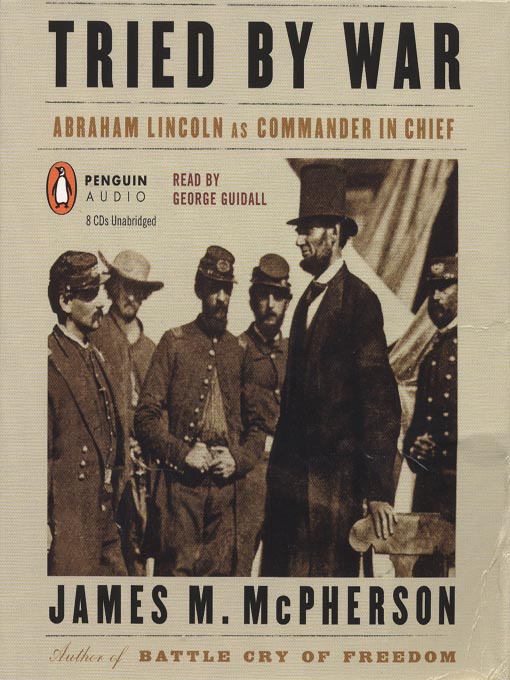
Tried by War by James McPherson

[Listened to this as an audiobook, if that matters to anyone.]

It's been awhile since I've had the pleasure of sitting down with a Civil War book. They tend to be a bit on the long side, and I've not had a lot of time to myself for pleasure reading. I decided to take advantage of my new, longer commute to pick up this study in command by James McPherson.

McPherson is a well-regarded historian who, I am somewhat embarrassed to admit, I've never read. There's a lot of Civil War books out there, and by the time I got to McPherson, I was already reading more specialized works on the war.

This book, however, intrigued me because of the subject matter. We all talk about Lincoln as being a great president, but the details as to why don't often get looked at very closely.

In this case, going from Lincoln's pre-inauguration days to the tragedy of his death, McPherson shows the progression of a man who knew about as much on the practice of war as I do on trigonometry when he first took office. By reading books, listening to a wide variety of opinions, reacting to practice, and dealing with the realities of war. In addition, Lincoln had to also juggle political actors, public opinion, and his own personal demons.

Any one of those things would be enough to break a lesser man, but Lincoln, in this rather glowing portrayal by McPherson, rises to the occasion. Honest Abe, despite his doubts, seems to be one step ahead of almost everyone around him, from the crafty cabinet members like Chase and Seward to military minds as diverse as Scott and McClellan.

In McPherson's account here, Lincoln had the right idea all along--he just didn't have the generals to implement the plans, until Grant, Sherman, Sherridan, and Thomas (an odd inclusion) came along. Once that quartet is in place, it's only a matter of time.

Similarly, Lincoln walks the tightrope of slavery here in a way that makes it seem as though the 16th president quickly transitioned from fighting for union to fighting for freedom, despite the displeasure of many around him. Father Abraham is nearly worshiped by freed slaves, and in the process, the struggles black soldiers faced to just get on the field (and be used in a meaningful way) is hidden into the background, with Grant's blatant racism completely overlooked.

True, McPherson does highlight Lincoln's failure with political generals and a few other mistakes, but they are waived away as being beyond Lincoln's control. The problem is that in the process, it looks like McPherson wants us to have it both ways--Lincoln is praised for his virtues, but not shown as being responsible for for his faults. It's a throwback to an earlier type of history book, where heroes are made to look as good as possible. I'm just not comfortable with the level of hero-worship on display here.

I also disliked the way that McPherson ignores the factors on the other side of the field that may have led to some of Lincoln's (and Grant's) successes. Jefferson Davis, despite being a former Secretary of War, was an idiot as a commander in chief. I also think even someone as cautious as McClellan could have won on the field by 1864, when the south's resources just dried up. Yes, the Union had a lot of bad generals, but the Confederacy had a lot of good ones, too. In the name of making Lincoln look better than his generals, I don't think McPherson properly takes circumstances into consideration.

There's also the tricky issue of Lincoln's shaky stance on the Constitution. Lincoln did a lot of things to create the Imperial Presidency, a style of managing that's great when it works, but lousy when the President's plans are less than stellar. McPherson says "other did worse" as the answer to this challenge to Lincoln's legacy, but overlooks that they all did it because *Lincoln did it first.*

Overall, Tried by War was a fun read, because it highlighted just how much Lincoln was involved in the war effort. As President, he acted in ways no one else has before or since, and his keen intellect often had the right idea. Focusing on Lincoln's army stovepipe hat is a worthy endeavor, and those looking to learn more about Lincoln's role in the war could do worse than to start here. I just wish McPherson had been willing to be more critical, or at least acknowledge there was more at play than just the Union side. When you finish Tried by War, I think you'll agree.

Monday, May 25, 2009

I Am America (and so can you!) by Stephen Colbert

We got this out in audio book form, and while the CDs are slightly abridged, I think that's probably the best way to approach this material. It's one thing to imagine Colbert's over the top stylings in your head; hearing the real thing makes it that much better.

"Shouted" by the author, this book is a spot-on parody of Bill O'Reilly's cliff-note for neocons books, just as the show is a blatant take-off of O'Reilly's TV show. Cobert pretends to genuinely espouse policies and opinions that are only slightly more out there than those proclaimed by real conservatives, with a little help from a few friends (Amy Sedaris and Jon Stewart, amongst others) along the way. Short and punchy, the book takes on subjects ranging from child-rearing to the elderly (who he says are hard of hearing so he insults them in low tones and then flatters them with shouted hackneyed compliments) to immigration (in which he brings the elderly back into things by suggesting they all be hired as border patrol, since they are very good at telling kids to get off their lawns).

If you're chuckling at that last line, you'll laugh out loud as you listen to Colbert try so very hard to pretend he actually believes the things coming out of his mouth. This is parody at its best--just sincere enough to make you think maybe it's real commentary. Or maybe I've just spent too much time on the conservative side of things and it's hard to tell their reality from Colbert's fiction.

There's so much fun to be had in this one--whether it's Colbert's starting off by his statement that he won't give the book to libraries (and if you borrowed the book, you're a welfare queen) or his stated distrust of books, knowledge, and reading--and the wonderful skewering of internet "fact" that goes along with this diatribe--even those who fall on the right side of the political fence should be laughing right along. If you are a fan of the show--and even if you're not--you really need to check this out. It's better than Al Franken's work and less pretentious than the Daily Show. Enjoy!