Sunday, March 25, 2012
Stealing the General by Russell S. Bonds
Enter James Andrews and one ambitious plan.
This book is the story of Andrews and his raiders, a band of twenty four men who volunteers for what was effectively a spy mission, despite later denials by the participants. Selected from the ranks of General Mitchell, a man who thought bigger than his manpower could handle, they infiltrated the southern lines through a Kentucky cover story and before anyone knew it, had stolen an engine, with the idea of destroying rail bridges and cutting the Confederacy in half.
It was an amazing plan. It also ended badly for eight of the participants, including Andrews.
Dogged by bad luck and the determination of one railroad man (Captain Fuller), the raiders are all captured, and the story of their survival (or death) is as heroic as any story in the Civil War. In the process, most of the Raiders would be the first to receive the most prestigious award in the United States: The Medal of Honor.
In this gripping and engaging narrative,. Bonds digs deep into a story that has mostly faded from the annals of Civil War history. I consider myself to be more knowledgeable about the Civil War than most people, and all I knew of this raid was that it was yet another failed Union scheme without much consequence. Bonds shows that, in context, the raid had a powerful effect on both the North and the South, and while it was doomed to failure almost from the start, its impact was lasting.
Taking the time to set the stage and show the problems in the Western theater during early 1862, Bonds describes the command failures of generals such as Buell and the intra-army jostling for position and prominence. This is the story not just of the Andrews Raiders, but of their commander, General O.M. Mitchell, whose fate would be to serve as an Icarus figure, who strove for the sun, burned his wings, and paid the price, dying in a departmental backwater of yellow fever. It is also the story of a deluded Confederacy, that constantly underestimated the raiders and was shocked that any Union troops could penetrate so far into their territory. It was a lesson they'd learn far more painfully in 1864, as Sherman took the same ideas that Andrews and Mitchell had, but used sufficient force to get the job done. Sherman's strike into the heart of the Confederacy was not unlike that of Mitchell--he just had roughly ten times the number of soldiers.
In addition to showing the grand scale, Bonds does an amazing job of using whatever first person accounts are available to detail the story of the raiders and the "great locomotive chase" giving an intimate picture of the story of the soldiers as they braved the rain to make it to the locomotive, their desperate ride on the rails and the many, many choices they faced before ultimately being captures. Hindsight is 20/20, but looking at the options shown by Bonds, it is clear that Andrews was in over his head once the chase got started, relying on bluffs to get by when force may have been needed.
The book's most difficult sections are the descriptions of the Southern prisons that the raiders must endure and the hypocritical court martial that leads to the death of Andrews and seven of the raiders. While the South regularly sent men north to do the same thing that Andrews and his men attempted, they acted as though the soldiers had committed an act of violence so heinous, that only death by hanging was appropriate. The North gave similar Southern prisoners the rights of soldiers. The South denied these men the same courtesy. It's yet another nail in the coffin of the myth of Confederate "honor" if you ask me. Bonds is more neutral, but to me, the way the raiders were treated was barbaric.
After several attempts, eight of the Raiders managed to escape and those still behind bars were eventually given their proper status as prisoners of war. Many of these men returned to serve in the Union Army once more, even participating in Sherman's March to the Sea, an irony not lost on them, I'm sure. Before this happens, however, several of them become part of a hallowed tradition, receiving the Medal of Honor. Bonds speaks briefly, in one of his many, but useful digressions about the award and its history, leading up to the current day.
Perhaps the most interesting part of this story is the conflicting accounts given by some of the participants. Bonds is clear when he's suspicious of a narrative and does not hesitate to state that he believes something to be false. He also tries, wherever possible, to show both sides of a story where the raiders (or their jailers) disagree on a particular point. The main chroniclers of the raid, Corporal (later Reverend) Pittinger and Captain Fuller, had axes to grind as they tried to make themselves look better than they probably were. It's a pitfall of many autobiographical works, and Bonds acknowledges that fact. However, given the spotty records of the time and the early deaths of many of those involved, such as General Mitchell and the hanged Andrews, sometimes these biased accounts are all that the author can use.
In the end, the Andrews Raiders probably could not have managed to bring down the Confederacy, even if they had managed to get their stolen train back to Union lines. Mitchell simply did not have the manpower, and his immediate superior had no desire to help his presumptuous subordinate. Their story, however, is no less amazing for its futility. This is a great book for Civil War enthusiasts looking to go deeper than just reading about the major battles. Bonds is an excellent writer in addition to being a solid, fact-based historian. If you want to learn about one of the most fascinating raids of the war and a story of determination, you can do no better than to read this book.
Saturday, June 4, 2011
An Account of the Battle of Wilson's Creek by R. I. Holcombe
Saturday, May 14, 2011
The Battle of Wilson's Creek by Edwin C. Bearss
This book is part of my 7-year Civil War Challenge, where I read books relating to the part of the Civil War that is 150 years old. 2011 is 1861.Sunday, December 5, 2010
Two Roads to Sumter by William and Bruce Catton
Progress so far: 2 of 5 books set in the pre-war era.
Bruce Catton formed the heart of my Civil War reading when I was growing up and first learning about the conflict. His books feel a bit old-fashioned now, showing as they do the best of the well-known names such as Lee, Grant, and Lincoln, without the touches of realism and human frailty that we expect from history books today.
Are we better off now that we know more about the men who waged the war, right down to their most personal problems? I'm not sure, but when you try to go back to the classics, it sometimes can be a jarring experience. Two Roads to Sumter spends a lot of its time trying to think the best of Lincoln and Davis, occasionally to the point of distraction. There's really not much you can do to make a man look better when he's advocating for the perpetuation and extension of slavery and denying the right of African Americans to participate in even the most basic aspects of American society.
Sorry guys, but Jefferson Davis might have been an upstanding gentleman who thought he was right, but you can't wash the taint off his hatred by couching it in context and high rhetoric. (It's a lesson I hope we'll soon see extended to the look back at extreme hatred in America today towards groups that did nothing but be different from the norm or look different from others.) The book is stronger in lionizing Lincoln, who certainly had his faults but clearly believed in human rights for all people, even if he wasn't as sure on the particulars or as free from bias as we'd like to think. Still, he too feels a bit larger than life here, able to rise above the petty manipulations of rival Seward, once he's been freed from the extreme partisanship that apparently marred his term in Congress.
Despite some of the problems inherent in writing in an age where criticisms of heroes were tricky to manage, the Cattons do bring interesting ideas to the table that were new to me. Lincoln's extreme partisanship and manipulations for power (I don't think I knew he ran for US Senate in 1854 as well, for instance) aren't as well documented, at least not in the books I'd read previously on the rail splitter. Similarly, I had no idea that Davis was often considered too conservative for his Southern audience, an irony that explains a lot about the problems faced by Jefferson Davis the President.
I also thought it was interesting that this book spends so much time looking at how the Democratic Party might have been able to stave off the war (and extend the life of slavery) by swallowing some pride and looking past the nose on their face to see the bigger picture. It confirms for me that American politics really don't work all that well and thinking they ever did was folly. It also shows how extremists can take control of the political process if given an opportunity, a lesson we're about to learn again soon, I think. In terms of the contemporary politics of the time, our pair of writers leaves no mistake that the feelings of the 1850s echo the 1950s in ways both similar and striking. Cleverly, they even leave those links for the reader to grab onto, rather than spell them out. It's a nice case of understatement that I think served the text well.
It's a bit hard to tell who is writing where, but the lengthy digressions into politics strike me as more from William, where the character profiles fits with those we see in Bruce's solo outings on the Civil War. The two mesh these ideas rather well, I think, with neither dominating. This prevents the book from either becoming too dry or too full of useless character studies that don't show how two of America's best known figures made their way through the years before the Civil War.
The book's central premise is that Lincoln and Davis, who both had roots in Kentucky, were not dissimilar men. They both came from the idea of frontier and expansion, though Davis would advocate it while Lincoln (perhaps in reaction to his father, an idea that's not explored here) rejects rampant growth, especially in light of the slavery question. They both had poor beginnings, but Davis gets a guardian angel in the form of an older brother. This is the key moment that changes the two men, as both face personal setbacks but only one has to really work for his opportunities. The difference gets more and more striking, as the book shows, until there's no way for these two men, who are arguably moderate for their day, to ever agree without bloodshed.
In this way, Lincoln and Davis are avatars for the regions they represent, two factions unable to come to terms because, like parallel lines, their visions for America could never co-exist as long as one based their philosophy on the slavery of an entire race. It took the war to, however unevenly, blend the two lines together. Two Roads to Sumter shows that, while possible, it was unlikely that anything other than the Civil War could have happened, given the actors in play at the time on the political stage. I think this book puts the lie to the idea that slavery would have died a quiet death if left alone. Possible? Yes. Likely? No. There were too many people trying to cling to outdated ideas, another echo of the 1950s and even today.
As I'd expect with most books that take such a specialized perspective on a part of history, this book is not going to have a lot of general interest. It is, however, one of the best books I've read on the pre-war years, however. (Keep in mind that's a limited number, so don't go by just me.) Unlike the book about the Compromise of 1850s, this text takes the time and space to explain is arguments, including why people such as Clay, Davis, and Lincoln acted as they did and what they might have done differently. I may not agree with the alternatives proposed by the book, especially the theory that President Douglas in 1856 might have saved the Union, but at least arguments are made that have real backing and explanation.
Those interested in the politics of the 1850s should definitely check out Two Roads to Sumter. It may have some problems that all older history books share, but it's still a strong study of the time period that presents logical arguments and crucial details I'd never seen before. It definitely belongs in the library of any historian of the Civil War era and should be of interest to fans of older American politics as well.
Sunday, November 21, 2010
At the Edge of the Precipice by Robert V. Remini
[This book is part of phase one of my extended Civil War 150th Anniversary Challenge.]It's rare that I get to read a book that came out the same year that I'm reading it, but this one jumped out on the shelf for me, in light of my plans to read books about the time before the Civil War for the rest of this year.
Remni's book features Henry Clay, a man who probably should have been a United States President, but never quite made it. He certainly tried enough times, but due to being the go-to man for compromise he always had just enough enemies that finding an electoral majority eluded him.
In this book, Remini acts almost as an apologist for Clay's role in making Faustian bargain after Faustian bargain regarding the worst sin this country is responsible for--the legalization and continuation of slavery. His main argument is that had the country split in 1820 (or later, and of the biggest focus in this book, 1850), there is no way that the forces of the North could have kept the South in the country, and further evils may have come about as a result.
What those evils are get left to the reader's speculation. Presumably it's that slavery would have continued for decades longer. That's certainly the implication when your book claims early on that the North needed another 10 years to prepare itself for war. I'd buy that argument except for one thing--it's not like the North was stockpiling weapons in safe territory or building up the size of its army. Hindsight might show that the North was better ready to fight for Union by 1860, but I don't think that was on Clay's mind. To imply that he was keeping the union together in order to wait for the right time to shut down the South's ambitions doesn't make any logical sense to me, hence why I feel that Remini is acting as an apologist.
The fact of the matter is that this book, in sticking only to the political wrangling and power games in Congress (logical, given Remini's role as a historian of the US House of Representatives), evades the central problem of looking at this period of history. While Clay, Webster, Calhoun, and others strove for oratory points, real Americans were being subjected to cruelty day after day. They were beaten, taken from their families, and assaulted, and America allowed it to happen for almost the first 100 years of its existence. (America then allowed it to happen again in a different form for the next 100 after that, and let's be honest, there's still issues here in the first 30 years or so of this third American century.)
Because the book is so heavily focused on Clay's desire to save the union at all costs, we don't get a look at those costs. It's interesting to read about how Clay, Webster, and others who might not have liked each other, worked in the end to delay what was certainly inevitable, if they really stopped to think about it. When Franklin, Jefferson, and others tell you that slavery is going to be a problem, no amount of redrawing borders or parliamentary wrangling is going keep things neat and tidy.
Though I was not happy with the tone of the book in terms of its dismissal of keeping African Americans in bondage for years, I do think it does a good job of showing that Congress really never has been good at fixing problems in this country. I think we have a myth that American government was better in "the old days" and a book like this shatters that to pieces. Look at how stubborn actors used their grudges to keep legislation at bay. See how Presidents fight members of their own party for control of the agenda. Note how legal tricks can doom a bill without getting off a single solid vote. Watch as crass men like Stephen Douglas rise to power by letting dreams die. Say what you really mean, as William Seward did, and watch as your political career dies.
It's sad when you think about it, but extremely instructive. Why think that today's politicians can make anything work when it didn't work before? Reading a book like this is almost enough to make you turn in your voting card.
In the end, At the Edge of the Precipice doesn't work well as a justification of Clay's actions in Congress as the slavery issue simmered. Since that's what the book was written to do, I don't think it serves its subject well. In order to make the claim, Remini would have needed to do more than just record the facts and give a few pieces of commentary. He'd need to dive deeper into the wider world of America at that time, something that doesn't happen in a book that's less than 200 pages.
As a book that shows how America's governmental system may be better than the rest, but still can't solve major problems, this book is a history lesson that doesn't give a lot of hope for the future as issues such as immigration, the environment, education, and job creation loom ever larger in the public's mind. That's the true story this book tells, and rather than a dream of possibility, it looks more like a nightmare. I don't think that was Remini's intention, but it certainly played out that way for me. Perhaps you'll have a different take.
Civil War Score: I don't see this as being a necessary read for anyone, unless you are very much into the history of Congress, Henry Clay, or early 19th Century American History. It's very much a niche book.
Wednesday, November 3, 2010
Civil War Book Challenge
The 150th anniversary of the Civil starts next year. It's a monumental anniversary for a conflict that still reaches out to us today and impacts on the lives of Americans, north and south. The Civil War was a defining moment in American History, and I've had a thing for studying it since I was in grade school.
So here's the challenge I'm throwing out there, and it's a doozy. It also covers the next several years. Hey, I'm nothing if not bold when I decide to do something!
For the rest of this year, read 5 books dealing with pre-Civil War issues.
For 2011 (1861), read 10 books dealing with the Civil War in 1861.
For 2012 (1862), read 20 books dealing with the Civil War in 1862.
For 2013 (1863), read 25 books dealing with the Civil War in 1863, including a mini-challenge of 10 books dealing with Gettysburg.
For 2014 (1864), read 20 books dealing with the Civil War in 1864.
For 2015 (1865), read 10 books dealing with the Civil War in 1865.
For 2016, read 10 books dealing with the era of Reconstruction.
Rules: No books I've previously read. No books dealing with biographies of particular generals unless it is about their actions in a particular year. No books about Lincoln, unless they deal solely with his re-election campaign in 1864 or his actions in a particular year. No books dealing with the Civil War in general or that cover more than one year.
Is this challenge insane? Probably. But it should be fun to watch. I'm starting with well-known Civil War writer Bruce Catton's book, "Two Roads to Sumpter."
Progress will be updated here periodically as well as on a special link at the top of the blog.
Anyone else want to give this a try? It would be more fun if I had a partner or two to keep pace with, but I'm willing to go it alone if I have to!
Saturday, September 25, 2010
Lines of Contention by J.G. Lewin and P. J. Huff
I have fondness for political cartoons, though I find that these days they tend to be a bit less clever than I remember them growing up. I have several books containing political cartoons on a variety of subjects, so when I saw this collection on a recent trip to Harper's Ferry, I jumped on the chance to add it to my shelf.Lines of Contention focuses on the many political cartoons of the Civil War, a time when all eyes--even those in Europe were on the United States and how a dark horse presidential candidate would deal with a major challenge to the idea of a united country in the face of a significant ideological difference.
These cartoons may be crude and offensive more often than not, but they carry with them the voice of a generation and show that popular opinion was as apt to swing violently then as much as it is now. We may ask for cleaner portrayals, but the shifting sands of opinion, blunt panic or belligerence, and generally weak understanding of details show up just as often here as they do in the cartoons of the week feature in a major magazine.
Lewin and Huff give a strong introduction to this collection discussing the importance of political cartoons (which may have started with none other than Benjamin Franklin) and how we can use them to see what people were thinking. I also like that they discuss the difficulty of mass reproduction, the large number of newspapers in the 1860s (Gettysburg alone had 11, if I am remembering correctly), and that just about every paper had a strong bias one way or the other, which comes out in these cartoons.
The book is structured into several chapters, and my only problem with the way the book is put together is that the cartoons are not always in chronological order. It can be a bit disconcerting, and I am a pretty solid Civil War buff. I do appreciate that each comic is given a context, and figures that might be familiar to a person with a Civil War Preservation Trust member but not to the general public are pointed out and explained. There were a few even I didn't know!
My favorite part of this book by far was that Lewin and Huff searched for less common cartoons to include, staying away for the most part from drawings we've seen a million times in other books. Jeff Davis in drag is pretty familiar by now, but how about Lincoln eating his treasury secretary as a fish? Or Lincoln cowering before the might of the British as a trapped raccoon (with likely double meaning)? There's even one of Congress as a bunch of unruly schoolboys, doodling and feuding during a lesson on the Constitution. I greatly appreciated the chance to see these kinds of commentary, and I think anyone who picks up this book will feel the same way.
If there is one thing I'd have changed, it would be to give a bit more attention to Confederate papers, or at least talk about why there are less of them. Were they too offensive for print? Burned and lost in Sherman's raids? Just non-existent? It's a question that we don't get an answer to, which is a bit of a shame.
Still, Lines of Contention was a great book to read and one I'm happy to own. It fills a gap in Civil War history for many readers, including myself, and really helps show what the public was thinking during the long conflict. If you or someone you know is a fan of both politics and the Civil War, pick up a copy of this book. You'll be glad you did.
Thursday, September 2, 2010
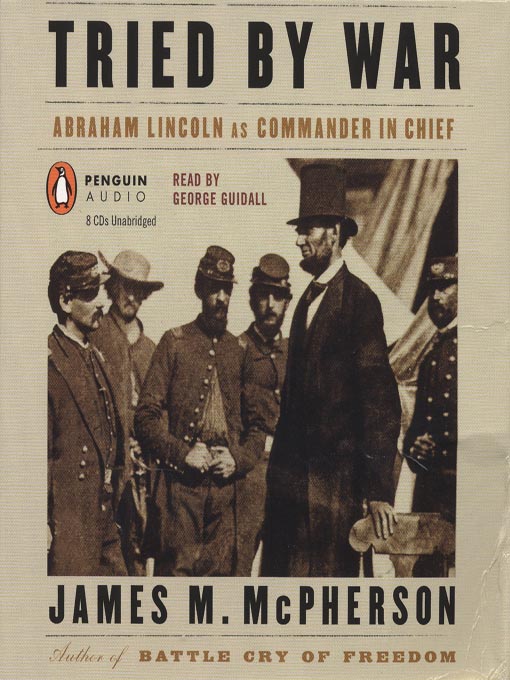
Tried by War by James McPherson
[Listened to this as an audiobook, if that matters to anyone.]It's been awhile since I've had the pleasure of sitting down with a Civil War book. They tend to be a bit on the long side, and I've not had a lot of time to myself for pleasure reading. I decided to take advantage of my new, longer commute to pick up this study in command by James McPherson.
McPherson is a well-regarded historian who, I am somewhat embarrassed to admit, I've never read. There's a lot of Civil War books out there, and by the time I got to McPherson, I was already reading more specialized works on the war.
This book, however, intrigued me because of the subject matter. We all talk about Lincoln as being a great president, but the details as to why don't often get looked at very closely.
In this case, going from Lincoln's pre-inauguration days to the tragedy of his death, McPherson shows the progression of a man who knew about as much on the practice of war as I do on trigonometry when he first took office. By reading books, listening to a wide variety of opinions, reacting to practice, and dealing with the realities of war. In addition, Lincoln had to also juggle political actors, public opinion, and his own personal demons.
Any one of those things would be enough to break a lesser man, but Lincoln, in this rather glowing portrayal by McPherson, rises to the occasion. Honest Abe, despite his doubts, seems to be one step ahead of almost everyone around him, from the crafty cabinet members like Chase and Seward to military minds as diverse as Scott and McClellan.
In McPherson's account here, Lincoln had the right idea all along--he just didn't have the generals to implement the plans, until Grant, Sherman, Sherridan, and Thomas (an odd inclusion) came along. Once that quartet is in place, it's only a matter of time.
Similarly, Lincoln walks the tightrope of slavery here in a way that makes it seem as though the 16th president quickly transitioned from fighting for union to fighting for freedom, despite the displeasure of many around him. Father Abraham is nearly worshiped by freed slaves, and in the process, the struggles black soldiers faced to just get on the field (and be used in a meaningful way) is hidden into the background, with Grant's blatant racism completely overlooked.
True, McPherson does highlight Lincoln's failure with political generals and a few other mistakes, but they are waived away as being beyond Lincoln's control. The problem is that in the process, it looks like McPherson wants us to have it both ways--Lincoln is praised for his virtues, but not shown as being responsible for for his faults. It's a throwback to an earlier type of history book, where heroes are made to look as good as possible. I'm just not comfortable with the level of hero-worship on display here.
I also disliked the way that McPherson ignores the factors on the other side of the field that may have led to some of Lincoln's (and Grant's) successes. Jefferson Davis, despite being a former Secretary of War, was an idiot as a commander in chief. I also think even someone as cautious as McClellan could have won on the field by 1864, when the south's resources just dried up. Yes, the Union had a lot of bad generals, but the Confederacy had a lot of good ones, too. In the name of making Lincoln look better than his generals, I don't think McPherson properly takes circumstances into consideration.
There's also the tricky issue of Lincoln's shaky stance on the Constitution. Lincoln did a lot of things to create the Imperial Presidency, a style of managing that's great when it works, but lousy when the President's plans are less than stellar. McPherson says "other did worse" as the answer to this challenge to Lincoln's legacy, but overlooks that they all did it because *Lincoln did it first.*
Overall, Tried by War was a fun read, because it highlighted just how much Lincoln was involved in the war effort. As President, he acted in ways no one else has before or since, and his keen intellect often had the right idea. Focusing on Lincoln's army stovepipe hat is a worthy endeavor, and those looking to learn more about Lincoln's role in the war could do worse than to start here. I just wish McPherson had been willing to be more critical, or at least acknowledge there was more at play than just the Union side. When you finish Tried by War, I think you'll agree.
Tuesday, April 21, 2009
Little Round Top A Detailed Tour Guide by Garry E. Adelman
Gettysburg is arguably the most-visited Civil War battlefield in the United States. Therefore, there are a lot of books written about it and one subsection of those books are battlefield guides—books that take all or part of the conflict and help the reader/tourist understand the fighting on a more detailed level. If you visit Gettysburg regularly—and I do—then at a certain point you want books that will take you to a certain section of the battle and walk you through the action step by step. “Little Round Top” is one of these books, and it's definitely highly recommended.
Adelman looks at the fighting on Little Round Top from a chronological perspective, rather than by walking across the top of the hill that sits at the eye of the so-called fishhook formation created by General Meade to defend at Gettysburg. Therefore, while a person walking along with the book may be a bit flummoxed by why they start at one end of the hill, move to the other, and then back again, (especially if it's ninety plus degrees and they have a hernia) the logic becomes clear as you read the text.
Fighting in a Civil War battle is never clean and neat, with a row of fighting moving left to right. It's a chaotic mess occurring—at least hopefully if you're the attacking party—several places at once. In the case of the fighting at Little Round Top, there's a need to get the perspective of General Warren first. Adelman helps you get into the mindset of those there at the time by telling you what Warren saw from the same spot that you are standing on.
From there, it's a bit of a walk to get over to the scene of the fighting made famous by the movie Gettysburg, namely Chamberlain's 20th Maine. Adelman walks you through the fighting by that famous regiment as well as its neighboring units, who actions were no less heroic—they just didn't get the top billing when the cameras rolled.
In this general area, there's a bit of nice commentary on the changing nature of the battlefield park. Sometimes we tend to think that the park comes into place whole, protecting things as they looked and nothing about it needs to be changed. Well, that's completely untrue. After all, there weren't neat paved roads, fences decay over time, and of course there's the constant threat of vandalism. Adelman helps the user of this guide understand the changing face of Little Round Top, winding it seamlessly into the narrative of the battle itself.
While the majority of the fighting did occur near Chamberlain's men, Adelman makes sure we know about the other troops involved that day. While their fighting was not quite as intense, other troops plugged the gap in the Union Line, preventing the Confederates from enacting their planned flanking maneuver. Warren grabbed troops from wherever he could, and by the end of the day (and the end of the walking tour), troops from New York and Pennsylvania manned the hill and kept the Confederates at bay, even doing a bit of late-day charging to make sure the position held the night.
The last stop on the tour is the location of an old amusement park on the battlefield. I wish I were kidding. Thankfully, we'd never stop to such crass commercialism today. Of course not.
As is appropriate for a work this detailed, Adelman gets into smaller work, such as the sweeping of the lower hill or the placement of little-known batteries of artillery. He also laces the work with pictures both old and modern to help the reader make sure they are in the right place. (Very key for a few of the harder-to-access locations.) There's also a set of visual challenges, though I did not attempt them.
Even though this is a small tour guide, Adelman notates all of his sources and references, just like a more formal work, should the tourist wish to delve into the material further. It's a nice extra touch that makes this such a well-constructed book.
One word of warning should you use this book—since it is nearly 10 years old now and the Park Service is working on redoing the battlefield, you may have a bit of trouble locating some of the tour stops. My friend—who's been to Gettysburg more times than I have and that's saying something—ran into a bit of trouble here and there. Also, when you go may play a large part in how adventurous you choose to be. I got mauled in briers and gave up trying to get across the face of the hill for location 7A.
With plenty of maps for each part of the tour and just enough description to aid the reader-viewer without bogging down into minutia, “Little Round Top” is a great book for veteran Gettysburg visitors to pick up and use on their next trip to the hallowed ground my friend refers to as the promised land.
Thursday, January 22, 2009
On the Bloodstained Field by Gregory A. Coco
This is not to say that other battles lack human interest. A lot of more modern books on the war try to capture the feeling of the common solider, with varying results. It's just that Gettysburg, because of its name recognition, tends to draw more memories out of the woodwork, leading to a plethora of books in the style of this one.
If you are a fan of anecdotes, then this is a book you'll love. Short, sweet, and grouped into the different phases of the battle, each story tells a small part of the battle from those who experienced it, or at least their best memory of what happened. I admit that I am skeptical of a lot of the book's stories, simply because so many of them are memories from long after the war was over. Time heals all wounds and embellishes all good stories, just anyone who ever hears any of mind. (Coco does provide a source for all the stories--it's not like I'm saying he's made them up. I am simply of the opinion that tales recounted over the fireplace in 1893 need to be looked at carefully.)
This is a very typical example of the material within, called "The Twelfth Battle":
"Just before the Battle of Gettsyburg, Sergeant Edward B. Rollins of Company A, 15th Massachusetts Infantry, sent a card to his wife with the name of eleven battles he had fought, beautifully inscribed upon it. He left space for inscribing one more name, and wrote to her that after he had fought in his twelfth battle, he would come home.
"He was killed at Gettysburg on July 2 -- his twelfth battle."
Not unlike a Twilight Zone episode, no?
Some of the stories, such as Hampton's duel or John Burns' wounds, are things I've read before. Others are light fare like a man who shoots in the air to "scare" the enemy. While the topic is deadly serious and the tales are often poinent, the reading depth is light. It's a nice break from deeper, scholarly accounts and a fun read for those looking for another way to witness the battle or material to tell the kids on vacation.
Sunday, December 28, 2008
Twilight at Little Round Top by Glenn W. LaFantasie
There are a ton of Civil War books out there, and of those books, tomes written about Gettysburg are probably the most numerous. Lord knows, I have at least a whole shelf of them, with more to come with each trip to the Battlefield.As a result, the quality tends to vary rather wildly. Authors take different tacks, type in differing styles, utilize differing facts, and so on, to make sure their book has a hook or angle that makes people want to read it.
"Twilight" is no different, except that in this case, at least for me, the authorial voice was ham-handed and trying at every turn to be a book that emphasized sound bites and minimized historical detail. Perfect for your uncle who only wants to read maybe five Civil War books in his life, let alone five in a month preparing for a trip to Gettysburg. Not so perfect for a reader who's expecting a more serious treatment, especially when the book itself is so specialized.
And that, if I may be pardoned for starting a sentence with and, is why the book failed utterly for me. I don't expect a general Civil War book to read like a clinical text or a scholarly essay. I don't even expect an overview of a large battle, such as Gettysburg or Vicksburg or even Manassas to get into too much minutia.
However, when your book is about not just a specific day of a specific battle, but of a particular *part* of that specific day, I expect something along the lines of a research essay expanded to the level of a book. I suspect that's also what most people would think, so when you're reading a book geared more to the "hey, I just saw something on TV about the Civil War" set inside the cover of a detailed title, there's a disconnect you can't get over.
What I can't figure is the thinking behind the book. Surely this is too detailed an account for those who watched and enjoyed "Gettysburg" but don't plan on joining the Civil War Preservation Trust, yet it reads just that way.
Here are a few sample quotes to give you an idea:
"Too often we forget that the Civil War transformed America into a bloody carnival of death."
WHAT? I'd expect that as part of a tour program, but a serious Civil War study? I find it hard to believe that anyone reading this book is out there going, "eh, it was only several hundred thousand lives so I could bore the wife and kids on vacation." The only thing forgotten here is the audience!
"Long after the war, Longstreet tried self-servingly to free himself of blame for the defeat at Gettysburg and earned instead the vilification of his former Confederate comrades in the Army of Northern Virginia..."
Umm, first of all, Longstreet was right. Secondly, he became an ally of the Union Reconstruction, never having been all that keen on secession in the first place, even joining the Government after the Civil War in aid of his old friend, President Grant. The sentence above is a woeful oversimplification that might be excused in a more general text but is out of place here.
"Beneith the mettle of a young professional soldier was a romantic heart that could croon a ballad before wielding the sword."
Do I even need to comment on this one?
I feel like it's a little unfair to pull such smal quotes out like this, but I could not think of any better way to explain my problem with the writing style. At every opportunity, LaFantasie throws in some melodramic text, either about how awful it was to be a soldier, how desperate things were, or how no one knew if they were going to see the dawn.
That might be what appeals to a certain type of reader, but that certain type of reader isn't me.
In addition, a lot of the early part of the book is taken up by setting the stage for the events on Little Round Top. It's not something that needs to go on for nearly 100 pages of a specialized book. About 25 pages of scene-setting would have been plenty for a book with a narrow topic. It would be like talking about 20 years of elections for nearly half of a book called "2008: The Debates."
This is really getting negative, which is a shame because I did like some of this book. I didn't really know the details of Warren's desperate attemps to get troops up the hill without a prior road--here's a General who got down in the muck and personally assisted in getting an artillary piece on to Little Round Top--for example. I also like the idea of showing how chaotic the battle could be, how certain players moved about, and so forth. I feel like I had a better idea of what took place after reading the book.
The trouble is that I would have been even better informed had the author took a little less time to personalize the account--there are first-person diaries aplenty for that, and are a better read (they often lack the "drama" factor that is in high gear here)--and more time to ground the reader in plain english. In other words, more "Sgt. So-and-So tried hard to rally his troops around a rock outcropping you can still see today" and less "Sgt. So-and-So kept thinking about his brother on the other side of the battlefield."
Does this make me a heartless person that doesn't care about the Carnival of Death? Perhaps from the author's perspective. I admit I'm more interested in the military details than in the life stories of every person who ever wore blue or butternut and grey. But I think in his attempt to humanize the struggle, LaFantasie went too far, and turned dramatic tension into a set of stereotypical soap opera cliches. In addition, the book takes too much time to get to its real subject, overdoing the oversiplifications along the way. That dooms the book to failure, at least in my eyes.
The blurbs call this a "face of battle" account. I guess that's just not something I much care for. However, if you really like the human side of things and want to read more about Gettysburg than in the Park Guide or a Bruce Catton trilogy, then you might like this one better than I did. If you're a serious Civil War scholar, however, you should let this one hang back with the 6th Corps in reserve of better titles.