Monday, October 28, 2013

Halloween Horror Extra: The Creature Recants by Dale Bailey

This is a special edition of my Halloween Horror series, which is running on my comics blog, Panel Patter. If you love horror, go visit! You can find all my entries by following this Halloween Horror tag.

I am a huge short fiction fan, especially in the realm of speculative fiction. I even write stories myself, with a publication upcoming in 2014. Among those of us who read and write short spec fiction, Clarkesworld Magazine is held in very high regard.

Each month, Clarkesworld publishes free short fiction online, usually three new stories and two reprints. They range from haunting tales that will make you cry to raunchy, irreverent stories with sexual themes.

The "third" story this month (named because they are read week by week in podcast form, also free) is The Creature Recants, by Dale Bailey, and I can think of no more appropriate story to recommend here in the best Holiday season, Halloween.

In this story, the Creature from the Black Lagoon is real, and working in Hollywood, getting advice from Boris Karloff in a brilliant cameo, and dealing with how his life changed the day he was brought into the world of humans by Amazon poachers.

The life of the Creature is a tragic one, as portrayed by Bailey. He knows he will be forever typecast and no matter how refined, human society cannot--and will not--accept him. He tries to make it work, but ultimately, the reader and the protagonist know that it cannot. When the story reaches a climax that is restrained yet brutal, we know what the Creature must do.

Bailey has a long trail of short story sales, including stories published in Lightspeed and the Magazine of Fantasy and Science Fiction, with a new story upcoming on Tor.com. It's easy to see how he's become so successful (including a few novels and a short story collection), as his prose flows off the page easily, each paragraph building upon the other to craft a full and complete story that leaves the reader satisfied.

Filled with nifty asides about being part of the Universal Horror machine towards the end of its life, the gimmicks of the movie industry, and the idea of identity, place, and perception The Creature Recants is not only a great Halloween-themed tale, it's an amazing short story that is one of the best I've read this year.

Check in out in prose form, but if you're of a podcast mind, Kate Baker really outdoes herself in the audio version. Either way, read this story today, and you'll soon see not only why I like it, but why Clarkesworld should be a part of your regular online reading rotation.

Saturday, October 26, 2013

Signal Boost: Support Kaleidoscope: Diverse YA Fantasy

Those who know me know that I am a big supporter of projects that interest me on Kickstarter/Indie Go Go/what-have-you, especially ones that are working to fill a niche that larger publishers with working budgets aren't able to.

I've found another one that I'd like you to consider supporting, because it's a great idea and as of this writing is falling short of its goal with only four days to go.

The project is called Kaleidoscope: Diverse YA Fantasy, and its goal is to create an anthology of YA-themed stories with protagonists who aren't seen with enough frequency in a publishing context. From the project page's description:
Too often popular culture and media defaults to a very narrow cross section of the world's populace. We believe that people of all kinds want to see themselves reflected in stories. We also believe that readers actively enjoy reading stories about people who aren't exactly like them. 
The main characters in Kaleidoscope stories will be part of the QUILTBAG, neuro-diverse, disabled, from non-Western cultures, people of color, or in some other way not the typical straight, white, cis-gendered, able-bodied characters we see all over the place.
Now that's not unusual as an effort in small publishing. However, if you don't do it right, the results are ham-fisted and don't tell a good story. What I liked about this project's plan--and the reason I chose to back it--was this additional comment:
 That said, these aren't going to be issue stories. The focus here is contemporary fantasy, and while the characters' backgrounds will necessarily affect how they engage with the world, we're not going to have a collection of "Very Special Episode" stories about kids coming to terms with their sexuality/disability/mental illness/cultural identity, etc. We want to see protagonists from all sorts of backgrounds being the heroes of their own journeys.
 That's extremely important. The key to a good story should always be the *story* not "Hey look, my characters are obviously gay!" or "See, I wrote this character as Black. Why are you asking about why she never faces any issues as a result of her race?"

It's a tricky balance, but I trust this one to work because of who is involved in the project. Julia Rios is a fiction editor at the highly regarded Strange Horizons weekly online fiction magazine. Strange Horizons regularly publishes fiction in which the characters fit the quiltbag designation. For example, a few weeks ago, the story was about two gay teens and how one lures in his paramours with a tale of a ghost who watches them make love. This past week's story features a girl who is picked on for being queer, even though she's not--she's just a tomboy. Given Rios' background, I fully trust her to be able to help select the stories that are the best, not just the ones with the best-fitting characters.

In addition, I have great faith in two of the committed contributors, Ken Liu and Vylar Kaftan, to turn in amazing stories to anchor the anthology. Liu's popularity is well-founded, being nominated--and winning--awards left and right this year. Kaftan is not only a great writer, but she's also strongly supportive of the rights of those whose voices often go unheard. They're solid picks for this project.

I am less familiar with the publisher, Twelfth Planet press, but the fact that this project comes from a small press with an extensive back catalog should help ease the worries of those who fear projects that fund but never deliver. It would significantly harm the reputation of Twelfth Planet if this doesn't see print, should it make its goal. They are also paying authors pro rates, which is a sign of professionalism.

Kaleidoscope is a wonderful project that deserves a place on the bookshelf. If you are interested in YA fiction and have $5 (or more) budgeted for a new book, consider putting it towards this one. I really want to see this make it, but it won't if we don't help get it started. Take a moment if you agree and pledge.

Friday, October 4, 2013

A Trip to the Baltimore Book Festival 2013

Baltimore Book Festival Entrance
This past weekend, Erica and I (along with friends Kelly, Sam, Sarah, Michael, and Nolina at various points) hung out for a bit at the 2013 Baltimore Book Festival. Despite living here for four years, this was my first time going, because honestly, I was usually too busy.

I made the time this year, and I am glad I did. It's really awesome to see a city like Baltimore, which has quite a few issues when it comes to its priorities, come together to celebrate the act of reading of all kinds.

And that was the thing I liked about this festival--whether it was romances, kids books, anarchy, or even cook books--the focus was on the printed/digital word. Even the vendors were primarily focused on books, with plenty of opportunities to grab used or new books for cheap, try out a indie author looking to break out into the next big thing, or even subscribe to a newspaper. Comics were sorted out into their own area, which is either good or bad, depending on your outlook, and of course the Pratt Library was out in full force, doing their "get carded" program.

The Short Fiction in Sci Fi Panel
Because of the variety, it seemed like the festival was serving a huge proportion of the Baltimore reading community, and I was pleased to see that it was a multi-racial affair. In fact, being blunt, it's about the most integrated I've ever seen Baltimore. (Readers are cool that way.) While walking around, I saw the tents containing the programming full to the brim almost everywhere, with the biggest crowds for the Romance and Science Fiction folks. (Fans of genres are nothing if not passionate.)

While I personally did not do a lot of panel-sitting--I'm notoriously bad at this if there's things to look at (see my visits to comic cons over at Panel Patter)--my friends did, and they came away very impressed with the quality of the presentations. One told me she'd learned a lot and was going to start putting certain ideas she got at the show into immediate practice to improve her writing craft. I realize I'm a bit biased because of the moderator, but Sarah Pinsker did another spectacular job running the short fiction panel, picking good questions and keeping all members of the panel on task and involved.

The Baltimore Science Fiction Society
I also appreciate that there's always a place for the more radical side of Baltimore to speak at the show, though I missed their stuff this time around. Another booth had a person talking frankly of the race issues in Baltimore and his experiences, which I thought was great.

For various reasons due mostly to jet lag, I didn't spend as much time at the Festival as I might have normally, but what I saw I thought was well run, with few hiccups or annoyances. The number of cops did give me pause (did they think there'd be a book riot or something?) and they need to turn the music down at the bandstand, but otherwise, I would recommend this little outdoor con without hesitation. It's free, pretty easy to get to by Baltimore transportation, and even worth the drive if you're just outside the area.

This will almost certainly be my own trip to the Baltimore Book Festival, but it was a good one, and I hope it continues for many years to come.

You can find a complete set of my pictures from the Baltimore Book Festival 2013 here.

Tuesday, September 17, 2013

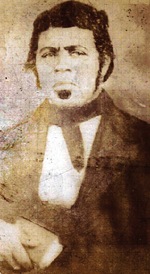
A Colored Man's Reminiscences of James Madison by Paul Jennings

Paul Jennings
Writing a tell-all book about your experiences in the White House is all the rage these days, whether you were a junior staffer or a member of the Cabinet.

But did you know that the first such memoir was written by a former slave, all the way back in 1865?

It's a little known piece of American History, one they don't teach you in school (but should), even if this book is more of a booklet by today's standards. Paul Jennings, slave to James Madison, was at his side for many years and respected so highly that Daniel Webster purchased his freedom after Madison's death to prevent him from being sold off by Dolly Madison.* (Jennings later worked off this debt to Webster.)

His life alone is pretty amazing, as he assisted with an attempt to rescue slaves via boat, and three of his children served with the Union in the Civil War. Fortunately, there has been a book written about him (by Elizabeth Dowling Taylor, in 2012) which I hope to read someday.

In the meantime, I highly recommend you check out his memoir, which you can read online for free via Google Books. It won't take you long at all to read, but it is definitely insightful. Dictated (I think) to a person named JBR, it has some interesting things to say about President Madison, working to confirm some details of his life and dispel myths at other points.

From the very start, the writing is engaging. He talks about how Secretary Gallatin was a "tip-top man" and noted that the Secretary of War "always agreed with Mr. Madison" which could explain why the disastrous War of 1812 happened. There's great urgency in Jennings' voice as he describes the fear and confusion of the burning of Washington. Particularly telling is that the Madisons were assured "there was no danger" which was of course completely untrue, but typical of the American approach to that war--arrogance bordering on stupidity.

Perhaps my favorite recollection here is the woman who threw Dolly out of her house, because "Your husband has got mine out fighting, and damn you, you shan't stay in my house; so get out!"

It's neat things like that which make this small memoir shine, especially when you learn their source is fellow slaves. Reading this is almost like finding a hidden history.

Jennings is very casual and conversational no matter what the topic. He discusses how the South refused to let the capital move north after the War--and you wonder how that might have changed the face of the Civil War had they succeeded.

Despite his poor treatment at her hands. Jennings is kind to Dolly Madison. While he does burst the "Dolly saved the Washington portrait" story, Jennings also refers to how well-liked she was and feels pit at her poverty at the end of her life. The man even gave he money to help her. That's a level of forgiveness I don't think I could share, were I in his shoes.

This book tells more in about twenty pages than many biographies do in two hundred. It's a great, short read that could probably be finished on your phone while commuting to and from work. Regardless, history fans really shouldn't miss this hidden gem, which is highly recommended.

*In typical "Virginia Founding Fathers Were Terrible People Mode," Dolly promised Jennings his freedom, then went back on it. Funny, that gets left out of the biographies for kids, too.

Tuesday, August 6, 2013

Signal Boost: Support Mothership: Tales from Afrofuturism & Beyond

I don't think I've ever posted on this blog about a crowd-sourced project before, but I really believe in this one and it's still a bit short of its goal.  As a disclosure, I am a backer of the project.

Mothership: Tales from Afrofuturism & Beyond--Support the Writer Campaign is raising funds for an anthology of speculative fiction written by by people of color. It's designed to be an opportunity to spotlight the fact that, despite what you may see in popular culture, there are plenty of extremely talented writers out there who aren't white.

The project is meant to open eyes to this fact, because all too often, it appears that only white writers get the attention or that white characters are the only ones out there in the realms of speculative fiction stories. It's a problem that I've taken a particular interest in since coming back from ReaderCon. I've always been aware of it, but now it's something that I want to actively challenge, both in my choice of fiction that I read and in how I write my own stories.

I think the project's description puts it most accurately:

When watching a work of science fiction on the big or small screen, people of color often find themselves asking:
"Where did we go?"
"Did some melanin-devouring plague attack all humanity?"
"Do zombies only like the dark meat?"
But that's Hollywood. While studio executives continue to show the world's multi-hued population through its monochromatic lens, the literary field of speculative fiction has become more diverse than ever. Whether it's horror, science fiction, or fantasy, steampunk or steamfunk (and let's not forget sword and soul), writers of color are producing quality works and accumulating accolades and awards every day.
 I am woefully ignorant of the vast majority of the contributors, which I hope to be able to fix once the project is funded. (I will allow myself the one caveat that given I work heavily as a review of comics, I can only spend so much time reading anything else, so my knowledge of modern fiction writers in general is far less than the average active reader, I'd wager.)  However, I can speak personally for the quality of Tobias Buckell's prose, whose first novel I read several years ago.  I also saw Anil Menon, Daniel Jose Older, and  Vandana Singh at ReaderCon on various panels, and all of them impressed me as authors I wanted to seek out and read from, based on their views about the nature of writing.

As of this writing, the project is a little over $3,000 short of its goal. It is a flexible funding campaign, so the project will at least be partially funded. But for $10, you can get an electronic copy of an anthology that has talented individuals working together to show that the world of the possible has as many shades as our own reality.

If you enjoy short fiction and have the funds available, please help this project meet its goal, both for your own reading pleasure and for the statement it makes that books like this are things we as readers want to see on our shelves.

Saturday, April 13, 2013

The Victory Season by Robert Weintraub

1946 was a year of transition for America, the world, and baseball, as this engaging book by Robert Weintraub, published just in time for the 2013 season, shows.

Part baseball history, part cultural background, Weintraub weaves a narrative of how baseball dealt with returning war veterans, the changing nature of the post-war America, and a challenge to its complete control of baseball players in an era of labor strife.  Placing the reserve clause in context of paralyzing strikes across the country, along with fighting with those who risked their lives for freedom over a few thousand dollars, really shows that the owners of baseball could be horrible people when it comes to money.

And that's before we get into their attempts to block the Dodgers from signing Jackie Robinson.

Weintraub also looks at how Rickey's integration of the game factors into this cultural maelstrom, using interviews with Mrs. Robinson to aid in bringing the trials of Robinson to the fore, even though he was "only" in the minors in '46.  Little anecdotes that are both tragic and heartwarming show not only the bald racism of the South (including a really bad show by Baltimore) but the quiet racism of defacto segregation in Canada and elsewhere.  I really enjoyed hearing about African American players involved in Armed Forces games in Europe, something I had no idea existed.

I would argue this book's greatest value is not in its retelling of the 1946 season (which focuses on the biggest names, teams, and events) but in bringing in background information that even a dedicated fan of the game may be unaware.  For instance, I had no idea there was an Armed Forces World Series or that they played baseball in German prison camps.  Weintraub goes into carefully researched detail about the major league players who lost their lives in WW2 or who made sacrifices nearly so great.  There's an awesome story about Larry MacPhail trying to capture the Kaiser in WW1 and we also get to see the wildly varying reactions of star players to fighting during their prime earning years.  It's a tribute to their greatness that some volunteered or tried to get out from cushy jobs to see action.

Because they were the two teams in the 1946 World Series, the book focuses a lot on the St. Louis Cardinals (an early adopter of the "build from the farm" strategy) and the Boston Red Sox (whose first real taste of the "Curse of the Bambino" begins here).  We also see the Dodgers, Yankees, and Cubs a fair amount, which is one of the few failings of Weintraub's writing--there's a definite focus on the bigger market teams. However, in fairness, in a book already boosted out over 400 pages, it would be hard to include more details.

The other issue the book has does relate to Weintraub's writing style, however.  He tries to mix a style that incorporates the breezy slang of both 1946 and 2012, and they often clash awkwardly.  While it may be true, I'm not sure hearing about Leo the Lip getting in someone's grille is the best way to phrase something.  I got used to this merging after awhile, but it may throw a few readers for a curve.

That's a minor complaint in a book that does so many things well.  While hailing the "Greatest Generation", Weintraub rightly doesn't treat them like gods.  He talks openly about the flaws of the owners (completely destroying the "baseball was better then" myth by showing just how awful the owners could be, including one story that leads to deaths), the players of the time, and the American people who did things like create false scarcity.  He's hard on Truman as a leader when referenced, and notes just how bad things were if you were a player, openly boggling at how the players allowed the owners to get away with so much.  I particularly liked his point about how we call people like Musial and DiMaggio "boys" but don't use the term nearly so often for the players before or since.  This was a unique group, operating in a different time, and Weintraub shows that to the reader.

Bringing the story of the 1946 season to life could have been a dull historical piece that retreaded ground covered by others.  Instead, Weintraub works hard to bring lesser-known factors to light, such as the attempt to get players to move to Mexico, an ill-starred idea that I think might have been the last major challenge to the supremacy of Major League Baseball.  Picking the best moments to highlight, we see players  fighting through injury, pivotal choices that may have changed history (making the Red Sox play 3 exhibition games before the World Series, of all things!), and ground-breaking moments (the first NL playoff).  The book is a real page-turner, because instead of a blow-by-blow, we see the things most interesting recounted, often on a more personal level than other histories have managed.

The Victory Season is not for the casual fan, clocking in at over 400 pages and covering territory that only those addicted to the game from an early age (like me) can appreciate.  For the person who counts down to pitchers and catchers reporting who wants to learn more about the game's history, this is a great present for them to read between innings of rooting for their favorite teams.

My thanks to Little, Brown, and Co. for providing me with a copy of this book.

Thursday, January 17, 2013

An Object of Beauty by Steve Martin

Lacey Yeager is almost as hot as the art she's involved in selling, using everything she knows to rise above her station in the art world.  Manipulative, cunning, and a bit lucky, she fights for a place in a world where the world million doesn't even need to be used.  Never failing to try and gain an edge, Lacey won't even let the events of September 11th stop her from hobnobbing with the elite and joining their ranks.  But sometimes, it's just not meant to be, as this fictional chronicle by Renaissance man Steve Martin shows.

Steve Martin has been a part of my cultural orbit for my entire life, whether it was Saturday Night Live re-runs, guest appearances, or his 1980s movies.  While his acting started to leave me cold over time and Martin himself gave up stand-up, the idea of Martin the writer has risen to be one of his greatest strengths.  Picasso at the Lapin Agile is a great play to read that I hope to see life someday.  I was happy to find this at the library, waiting to be grabbed, and I'm glad I was the person who found it.

For those who don't know, one of Martin's interests is art, and he uses that interest to really infuse this book with knowledge and opinion about damned near all of the art world, giving it a basis in the real world that another writer could not manage if they set their world in the same aura of big-name art dealing.  When the characters in this book discuss Warhol's place in the pantheon of artists or the way certain painters are either ignored or "discovered" over time, you can tell it's not just research for Martin.  These are things he has either discussed or considered on his own.

Similarly, Lacey's rise to power, using her positive and negative traits to get to the point of owning her own gallery, are frequently marked with allusions to other kinds of stardom.  I don't doubt that Martin, in his trek from Disney employee to the star of the Pink Panther remake (in some ways, a rise and fall all its own), encountered people, male and female, who were not above crossing the borders of legality to try and gain an edge.

And that's the thing that really makes this book so good.  I'm an amateur art geek who is conversant from Egyptian art to the Pop era.  I have so many holes in my knowledge that people use my art expertise as a golf course, but I love going to galleries and have over time developed a way to understand what makes one painting better than another from the same time frame.  For me, the talk of Rembrandt, Matisse, and others both real and imagined meshed well with what I knew and really gave the story depth.  But if I only knew a Van Gough when the signature was pointed out to me, I could still appreciate Lacey and her story.

After all, isn't it the most American thing to do, over the course of the 90s and 2000s, to do everything you could to rise to the top, even if it was a house of cards, ready to tumble?  The dot com bubble, the housing bubble, the impending student loan bubble--they all result from the fact that we as American lust to be the richest thing around and will often do stupid things (like take out a second job to afford a more fashionable car we can't drive in because we have to work so much) just to look "better" than the rest of humanity.  Just as Lacey's actions that generate the wealth she needs to move from auction house girl to world traveler eventually banish her to the backwaters of the art work, America's actions over the past half century are quickly placing us in company with Greece instead of China.

In the end, Russia may just bury us after all, just like those who Lacey tries to screw over end up burying her.  Given that Martin sets this story to coincide with the boom and bust of America's overall economy, I think he's purposefully going for the comparison.  Lacey and the art world are avatars for Martin to make social commentary, using a literary device that goes back at least as far as Homer.

To be a good book, however, requires more than just an ability to comment.  While Martin probably will never be the best at narration, his dialogue is razor sharp, echoing without repeating his best acting work.  There were many times where I could hear Martin mentally while the character spoke, giving the story a lot of life and energy.  This was really needed because often the characters are unlikable (either rich bores or people on the make) and when Lacey says things like how she was sad there was no crime after failing at her "Lacey Drew" impression, the comedic timing is perfect.

My only real issue with the story is that I found the narrator to be an off choice.  Martin picks an art critic who was briefly a lover of Lacey's and later her dupe to tell Lacey's story, blurring whether it is fact or fiction within the context.  He's not a loser, but he's the kind of person who always ends up being an also-ran, and compared to Lacey, he's a dullard who can only reflect her light.  I guess that's the point, but I feel like the book might have been better served by keeping the narrator out of the story entirely.  You can tell Martin is trying to be post-modern, but I think it was one layer of clever too many in an otherwise really good book.

An Object of Beauty has a lot going on, just like the best paintings.  It's both a case study, an admiration of audacity, and a warning to those who will do anything to win.  Martin's got a great feel for intricate writing such as this, and I hope he continues to pour energy into books such as these and less facile films that play upon his reputation but don't play to his strengths.